
By now, you've tried the tools.
ChatGPT. Claude. Maybe Jasper or Notion AI. You asked it to write a blog post, got something back in 30 seconds, and felt a brief moment of excitement before reading it and thinking: this is fine but it sounds like everyone else's content.
You're not wrong. Most AI-generated content does sound like everyone else's, because it was trained on everyone else's content. That's the fundamental tension, and most articles about AI writing tools dance around it.
This post doesn't. As an agency that runs AI in production content operations, we've had to think through this clearly: where AI content creation actually works, where it reliably fails, and what the workflow looks like when you want real results, not just content volume.
Why Most SMEs Are Using AI Content Wrong
The dominant mental model for AI content tools is: input prompt, get output, publish. It's treated as a shortcut — a way to eliminate writing time entirely.
That's the wrong model, and it's producing results that range from mediocre to actively harmful.
Here's what the shortcut model actually produces:
- Generic content with no brand voice, no specific insight, no real POV
- Posts that answer questions nobody is asking with no keyword strategy behind them
- Content that reads like content, not like a person who knows something
Google's helpful content guidance is increasingly good at detecting this pattern. Content that exists to exist — to fill a blog, to "do SEO" — is algorithmically weaker than it used to be. Volume without quality is not neutral. It can actively dilute your domain's trust signals.
The businesses getting real value from AI content tools are not using them to eliminate human work. They're using AI as infrastructure: a layer in a deliberate workflow that starts with human strategy and ends with human review. The AI handles the parts it's good at. Humans handle the parts it isn't.
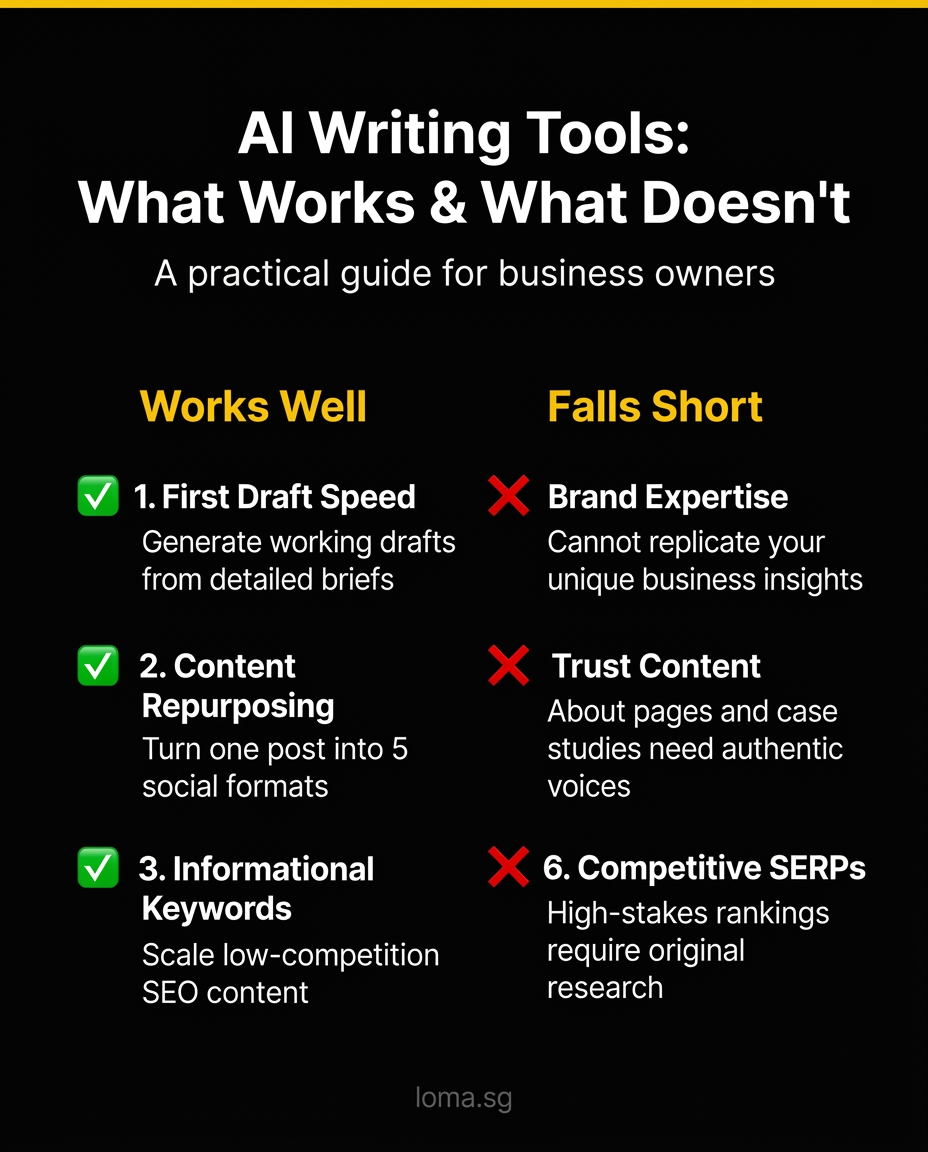
That distinction matters. Here's what the accurate map looks like.
What AI Content Creation Is Actually Good For
First-Draft Acceleration
The blank page is genuinely where AI earns its keep. Given a detailed brief — target keyword, audience, angle, structure, tone notes — AI can produce a solid working draft in minutes. Not a publishable draft. A working draft.
That's not a trivial contribution. For a marketing team writing 4-6 posts a month, first-draft acceleration cuts writing time by 50-70%. Not because AI replaces the writer, but because editing is faster than drafting from scratch.
The key word is "brief". Vague prompts produce vague content. The more specific your input — keyword intent, audience context, competing articles you want to differentiate from, examples of your brand voice — the better the starting point.
Content Repurposing at Scale
This is where AI content tools are genuinely underrated. Taking a long-form blog post and producing:
- A LinkedIn post summary
- 3 social media captions
- An email newsletter paragraph
- 5 tweet-length insights
- A short-form video script outline
...manually takes hours. With AI, it's 10 minutes. The source content is human-written. The AI is handling format translation, which it's good at.
Repurposing at scale is the highest-value AI content use case for most SMEs, because it multiplies the reach of content you've already invested in.
SEO-Driven Informational Content
For informational keywords — "what is X", "how to Y", "guide to Z" — AI drafts are a reasonable starting point if you have a clear keyword brief and a human editor who can add specifics.
This is the category where AI content is most competitive with human writing: the reader is looking for information, the keyword intent is clear, and the bar is set by existing generic content. If your human editor adds one or two specific insights that the AI couldn't know, you have a post that outperforms the generic alternatives.
This doesn't apply to competitive, high-stakes keywords where depth and original research are the ranking differentiators. But for a 50-keyword informational cluster at low-to-medium competition, AI-assisted drafts with human editing can move fast.
Scaling a Trained Brand Voice
Once you've documented your brand voice in enough detail — tone, vocabulary preferences, things you never say, examples of writing you want to sound like — AI can apply it consistently at scale. Not perfectly. But consistently enough that editing feels like minor refinement rather than full rewrites.
This takes upfront investment: you need to write the voice guide, test it, refine the examples. But once that system is in place, it's infrastructure. New writers (human or AI) onboard to the same standard.
Where AI Falls Short (Honest Assessment)
Brand-Specific Expertise and Original POV
AI doesn't know what your business has seen. It hasn't had the conversation where a customer revealed a problem you'd never considered. It hasn't run the campaign that failed in a way that taught you something. It hasn't navigated the specific operational challenge your industry faces in this market.
That accumulated experience is what makes content actually worth reading. It's the difference between a post that could have been written by anyone and one that clearly comes from someone who knows what they're talking about.
AI can imitate the structure of expertise. It can't generate the substance. Any content that requires original insight, specific data, or genuine POV needs that material to come from a human — and the AI is just help with assembly.
Relationship-Building Content
LinkedIn founder posts. Personal brand content. Case studies with real customer quotes. The "lessons from 5 years running this business" post.
This content works because it's personal and specific. AI can write something that looks like it, but audiences are increasingly good at detecting the absence of a real human behind content. If the goal is to build trust and relationship with an audience — not just rank on Google — AI-generated content reliably underperforms.
Highly Competitive SERP Content
For keywords where the top-ranking content is detailed, well-researched, and clearly written by subject matter experts, AI drafts don't win. The ranking bar is set by original research, proprietary data, detailed analysis, and depth that comes from knowing the subject.
Putting an AI draft against Ahrefs, HubSpot, or Search Engine Land for a competitive term is not a fair fight. The answer isn't better prompts. The answer is producing content that those resources can't produce: local case studies, specific examples, original primary research.
Trust-Signal Content
About pages. Case studies. Client testimonials. Team bios. Service descriptions that explain specifically how you work.
This content signals credibility and authenticity to buyers at the consideration stage. It needs to sound like real people describing real work. AI-written service descriptions that technically describe your offerings but feel generic signal — to sophisticated buyers, if not to everyone — that nobody bothered to write it properly.
This isn't where you use AI. It's where you write.
The Workflow That Works: Human Strategy, AI Execution, Human Review
The pattern that works in production looks like this:
Step 1: Brief (human work) Define the keyword, audience, angle, desired outcome, and tone before prompting. This is strategy. If you skip this, you'll get generic output regardless of how good the AI is.
Step 2: First draft (AI) With a complete brief, get the AI to produce a structured first draft. Review the structure before editing the prose — if the structure is wrong, fix it before you spend time on sentences.
Step 3: Edit for voice, accuracy, and specificity (human work) This is where the real work is. Add specific examples. Replace generic claims with things you can actually support. Cut filler. Make it sound like a person. If there's an original insight in the piece, this is where it goes in.
Step 4: Review before publishing (human sign-off) Anything client-facing, anything that makes specific claims about results or capabilities, anything that could create trust or credibility risk — a human has to read it before it goes out. This is non-negotiable.
The mistake is treating Step 3 as optional. The edit pass is where the content goes from "AI output" to "content worth reading". Skipping it is why most AI content disappoints.
What LOMA Does: AI-Assisted, Not AI-Generated
We use AI in production content operations. Not as a gimmick. Because the workflow above produces good content faster than purely manual production — when the strategic layer is human.
Our content process: briefs written by a strategist who knows the keyword landscape and brand context. AI drafts reviewed and edited by writers who understand the subject matter. Quality scoring before anything gets published. Human approval for anything above a quality threshold.
The result is content that reads like it was written by someone who knows what they're talking about — because the decisions about what to say, why, and for whom were human decisions. The AI helped with the how.
For clients, this matters because you want content that converts, not just content that exists. More posts at lower quality isn't a content strategy. It's content debt that will cost you more to clean up later.
The Practical Takeaway
AI content tools are useful. They're not a replacement for content strategy, original thinking, or human editing.
If you're using them as a shortcut, you'll get shortcut results. If you're using them as infrastructure — a layer in a deliberate workflow — you can produce more and better content than your manual capacity allows.
The businesses that will win on content over the next few years aren't the ones producing the most AI content. They're the ones producing the best content using AI as one tool in a considered process.
Want Content That Actually Performs?
LOMA's approach to digital marketing combines AI efficiency with human strategy. We don't churn out AI content and call it done — we build content operations that are genuinely better because of AI, not just faster.
If you want to understand what an AI-assisted content strategy looks like in practice for your business, talk to us. We'll tell you what would actually move the needle.