
Most AI chatbots for SMEs answer the wrong questions. Here's how to avoid building one that frustrates customers and embarrasses your brand.
You've seen the demos. A sleek chat widget pops up. It greets visitors by name. It answers questions about opening hours and returns policy in seconds. The sales pitch is compelling: reduce support tickets, free up your team, be available 24/7.
Then you deploy it. Three months later, your staff is still fielding the same questions — because the chatbot loops customers into dead ends, escalates everything it can't handle (which is most things), and has been quietly disabled on mobile because it broke the layout on iPhone.
This is not a rare outcome. It's the typical one for SMEs that deploy AI customer service without a clear scope. The problem isn't the technology. It's the implementation.
Here's what actually goes wrong — and what a working setup looks like.
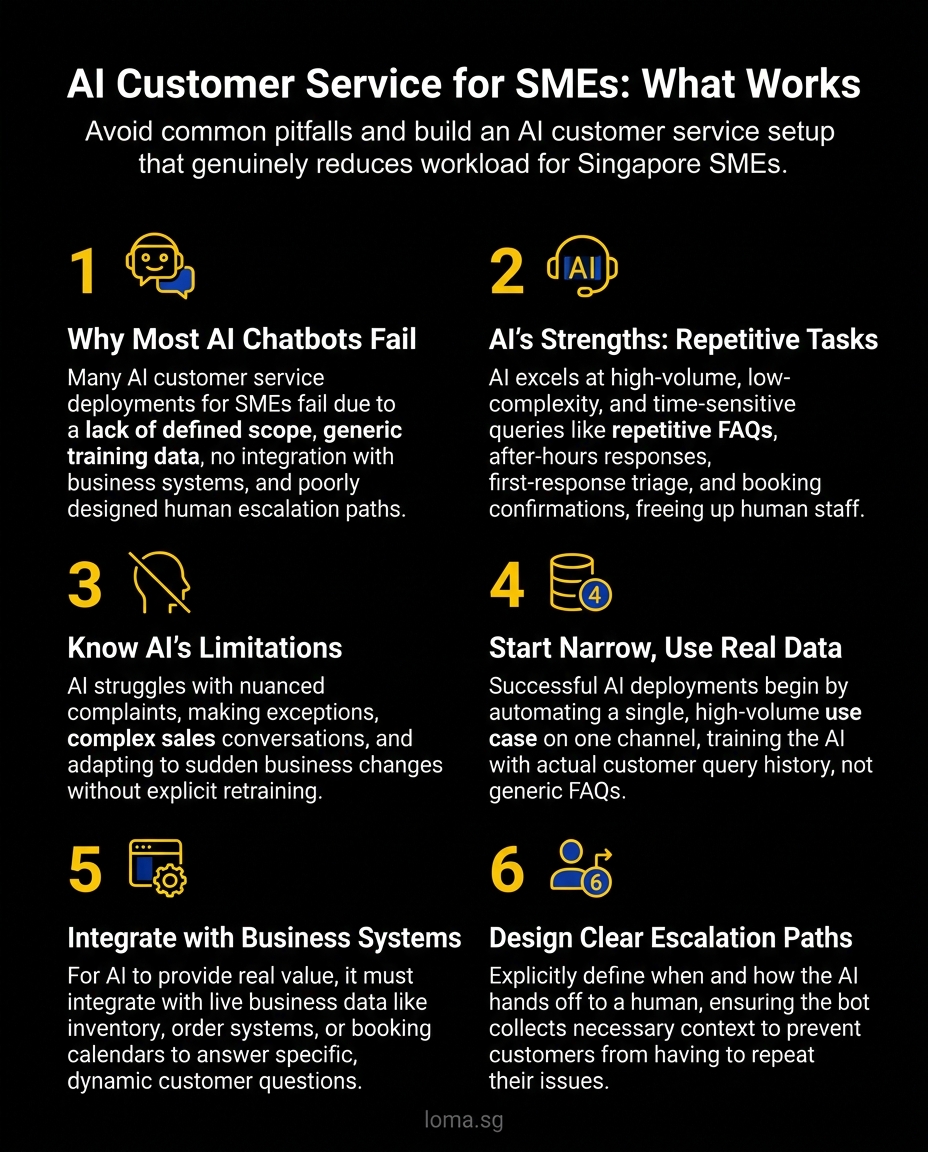
Why Most SME Chatbot Deployments Fail
Deployed without a defined scope
Generic chatbots are trained to handle anything. When they try to handle everything, they handle nothing well. A chatbot that attempts to answer questions about pricing, product specs, order status, refund eligibility, delivery timelines, and custom requests will give vague, hedged answers across all of them.
The failure mode is subtle: customers get a response, but not a useful one. They ask a follow-up. The bot loops. They leave frustrated. Your team never sees the conversation — it was technically "resolved" by the bot.
No training on actual customer questions
Most deployments start with a generic FAQ template: "What are your opening hours?" "Where are you located?" "How do I return an item?" These are fine as starting points. The problem is when they're used as the final training set.
Your customers don't ask generic questions. They ask: "Can I change my delivery to Thursday?" "Is the XL still available in white?" "I ordered two days ago and haven't received a tracking number." If your chatbot wasn't trained on your actual query history, it will miss the questions that matter.
No integration with real business data
A chatbot that can't check your inventory, order system, or booking calendar can only tell customers what they could already find on your website. It adds no real value — it just puts a conversational veneer on static information.
For retailers, F&B operators, and service businesses, the queries customers most want answered ("Is table 4 available at 7pm?" "Is this item back in stock?") are exactly the ones a disconnected bot can't answer.
No escalation design
Every AI customer service deployment needs a defined handoff: when does the bot step aside and route the customer to a human? Most deployments treat this as an afterthought — a vague fallback that says "contact us at hello@yourbusiness.com."
When escalation is designed poorly, customers get stuck. They've already told the bot their problem twice. Now they have to start over with a human who has no context. This is worse than not having a bot at all.
What AI Customer Service Is Actually Good For
Done right, AI handles a specific class of problems extremely well: high-volume, low-complexity, time-sensitive queries. Here's where SMEs see real returns:
Repetitive FAQs at scale. Hours, pricing tiers, location, parking, product dimensions, return policy. These questions are asked constantly, the answers don't change often, and they require no judgment. A well-trained bot handles these instantly — freeing your team for conversations that actually need a human.
After-hours coverage. Singapore customers send WhatsApp messages at 11pm. Most SMEs can't staff that. A well-configured AI assistant on WhatsApp can capture intent, collect order details, answer common questions, and let the customer know someone will follow up first thing tomorrow — with context already gathered. That's a meaningful improvement over silence.
First-response triage. Not answering the question — routing it correctly. Capture what the customer needs, collect the relevant details (order number, date, product name), and get it to the right person with context. This alone can cut response time significantly.
Booking and appointment confirmation. For F&B, clinics, salons, and service businesses with structured scheduling: AI can handle booking confirmations, reminder messages, rescheduling requests, and waitlist management. These are rule-based, predictable, and high-frequency. This is where automation genuinely replaces manual work.
What AI Customer Service Still Can't Do
Knowing the limits matters as much as knowing the capabilities.
Handle complaints with nuance. A customer who received the wrong order and is genuinely angry needs a person who can make a judgment call — apologise with authority, offer a meaningful resolution, escalate if needed. An AI that says "I'm sorry to hear that! Here's our returns policy" adds fuel to the fire.
Make exceptions. "Can I get a refund even though it's been 35 days?" requires someone who can assess the relationship, the context, and the business risk. AI has no authority to make that call, and any attempt to handle it will either be too restrictive (customer loses, loyalty gone) or too permissive (exploited at scale).
Replace a salesperson for complex queries. If your product requires a conversation — if the answer to "which package is right for me?" depends on budget, use case, team size, and goals — a chatbot isn't the right tool. It's a lead capture form with extra steps.
Adapt to sudden changes without retraining. A product recall, a pricing update, a new store closure. If your AI hasn't been updated, it will confidently tell customers the wrong thing until someone notices. Unlike a human team you can brief in five minutes, an AI assistant requires intentional updates to stay accurate.
The Setup That Actually Works
There's a consistent pattern in AI customer service deployments that deliver measurable ROI. It looks like this:
Start narrow: one channel, one use case, real data. Don't try to automate all customer queries from day one. Pick the highest-volume, most repetitive query your team handles — the one your staff could answer in their sleep — and automate that. Once it works reliably, expand.
Train on your actual query history. Export your WhatsApp conversations. Pull your email support tickets. Look at what customers actually ask, in their actual words. The difference between a bot trained on generic FAQs and one trained on real query data is the difference between a frustrating tool and a useful one.
Design the escalation explicitly. Before you deploy, answer these questions: What triggers escalation? What information does the bot collect before handing off? Who receives it? What's the expected response time? Document this and build it into the configuration. It's not a nice-to-have — it's what separates a functional deployment from a loop of frustration.
Integrate with real data. If you're in F&B: connect to your booking system. If you're in retail: connect to your inventory. If you're in professional services: connect to your calendar. A chatbot that can answer "yes, that time slot is available — want me to confirm?" is genuinely useful. One that can only say "please call us to check" is not.
Measure what matters. Track resolution rate (queries resolved without escalation), escalation rate (how often it hands off), and response time against baseline. Not follower growth. Not chat opens. Whether the bot is actually reducing your team's workload.
What LOMA Builds vs. Generic Chatbot Tools
There's a meaningful difference between a generic FAQ bot and a commerce-native AI assistant.
Generic chatbot tools — the kind with a free tier and a drag-and-drop interface — are fine for answering three static questions. They're not built for businesses where customer queries involve real transactions: order status, product availability, appointment slots, custom requests.
LOMA's AI Assistant service is built differently. It's connected to your actual business data — inventory, orders, customer records, booking systems. It's designed for the channels Singapore customers actually use, WhatsApp first. It handles multilingual queries where needed (English, Mandarin, Malay) without falling apart when a message mixes languages.
It's also designed from the start with escalation logic. Not as an afterthought. Every deployment includes a defined scope (what it handles), a defined escalation path (what it doesn't), and a monitoring setup so you can see resolution rates and catch edge cases before customers do.
The honest pitch: if you're evaluating AI customer service tools and your business involves complex product queries, live availability, or relationship-sensitive customer interactions — a generic chatbot will disappoint you. A well-scoped AI assistant built on your actual data won't solve every problem, but it will solve the ones worth solving.
The Minimum Viable AI Customer Service Stack
Before investing in a full AI assistant deployment, check whether you have these in place:
- A documented list of your top 20 most common customer queries (not guessed — pulled from actual message history)
- A clean data source for the information customers most frequently need (pricing, availability, hours, policies)
- A defined escalation path with an owner who is accountable for handling escalations within a stated timeframe
- One channel where you'll launch first — preferably where most customer queries already happen
- A baseline metric to measure against (current average response time, volume of repetitive queries per week)
If you have these, you have what you need to run a pilot that shows real results. If you don't, start there before evaluating any AI tool.
Ready to Build Something That Actually Works?
LOMA builds AI assistants for Singapore SMEs that go beyond FAQ bots — connected to your real business data, designed for WhatsApp, and built with escalation logic from day one.
If you're evaluating AI customer service tools or had a chatbot deployment that underdelivered, talk to us about LOMA's AI Assistant service. We'll tell you exactly what we'd build for your business — and what we wouldn't.
See how we approach digital marketing for Singapore SMEs as part of a broader customer experience strategy.