Most service pages are written like brochures. That was already a weak move for SEO. For generative engine optimization, it is worse. If your page is vague, bloated, or afraid to say anything concrete, AI systems have nothing useful to cite.
This matters because high-intent buyers are no longer only clicking blue links. They are asking ChatGPT, Perplexity, Gemini, and Google AI Overviews who to hire, what to compare, and which provider looks credible. Service pages sit close to the money. If those pages are unclear, your brand gets filtered out before the sales conversation even starts.
Good GEO SEO for service pages is not about stuffing in more keywords. It is about making your offer easy to understand, easy to trust, and easy for AI systems to extract into a recommendation.
Why service pages matter more in AI search
Blogs still matter. They build topical authority, answer early-stage questions, and give you more surface area to be discovered. But service pages carry a different kind of weight. They are where buying intent becomes commercial evaluation.
When someone asks an AI tool, "Which agency can handle AI SEO for a service business?" or "Who offers generative engine optimization for SMEs?" the model is not looking for clever thought leadership alone. It is trying to assemble a shortlist. That means it needs pages that clearly define the service, explain who it is for, show proof, and remove ambiguity.
A generic blog post can help you appear in the conversation. A sharp service page helps you survive the shortlist.
This is where many businesses get lazy. Their homepage sounds polished. Their blog sounds informed. Their service pages, the pages that should close the credibility gap, sound like recycled agency wallpaper.
That hurts traditional search, and it hurts AI search even more.
The five elements AI-ready service pages need
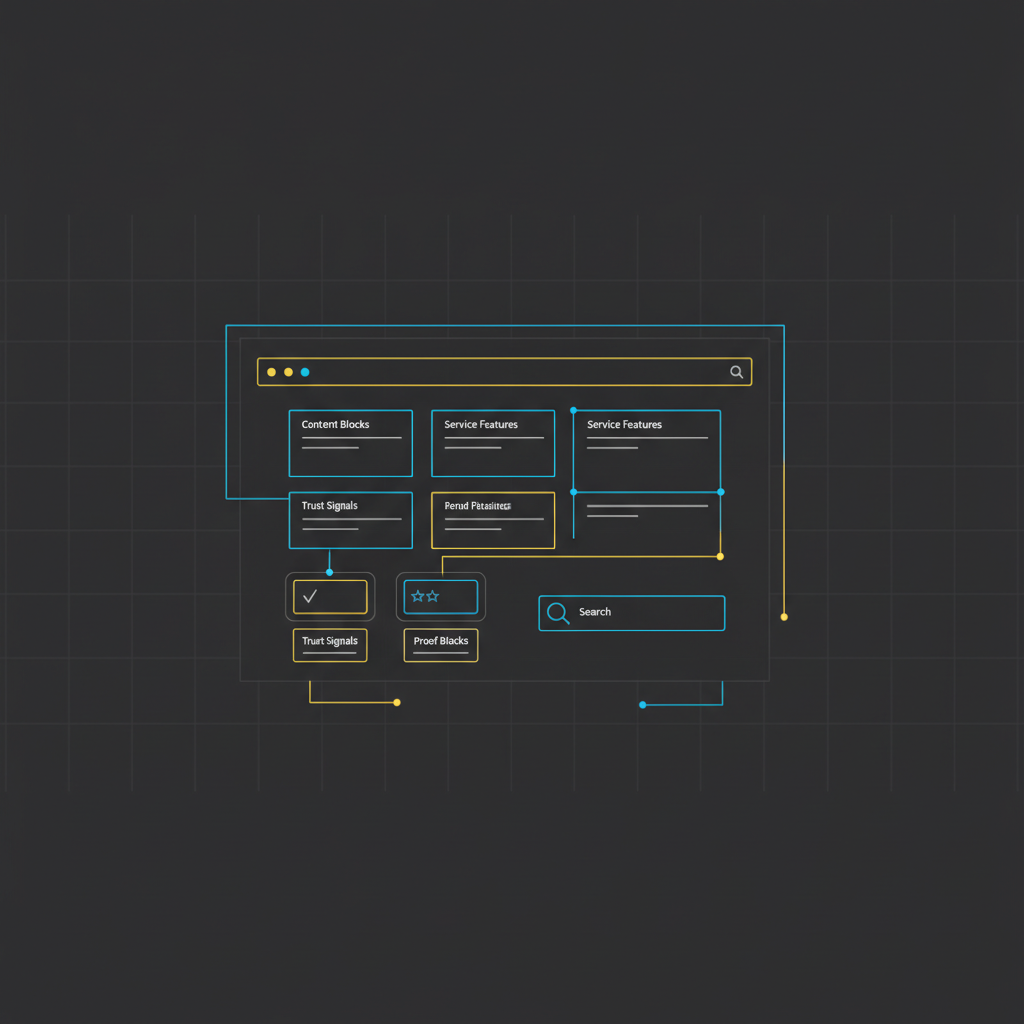
If you want to know how to get cited in AI search, start here. A service page should make five things obvious within one quick scan: what category you belong to, what exactly you offer, why someone should trust you, what makes you different, and how quickly the page answers real buyer questions.
1. Category clarity
AI systems need clean labels. Humans do too.
If your page calls the service "growth acceleration architecture" or some other self-indulgent invention, you are making the page harder to classify. Use the category your market actually understands. If the page is about generative engine optimization, say that plainly. If it is about ecommerce development, say that plainly.
You can still frame the service with a sharper angle. Just do not hide the category under branding.
This is one reason focused service architecture matters. A page like LOMA's AISEO service is easier to interpret than a vague catch-all page trying to talk about SEO, content, PR, automation, and analytics in one breath.
A practical check: could a buyer, or an AI model, identify the exact service category from your H1, your opening paragraph, and your first subheading? If not, fix that first.
2. Offer definition
Category tells people what bucket you sit in. Offer definition tells them what you actually do.
A surprising number of service pages never explain the scope of the work. They say things like "we drive visibility" or "we create tailored strategies" and somehow expect buyers to fill in the blanks. That is not positioning. That is laziness with a nicer font.
A strong service page defines the offer in operational terms:
- what is included
- what problems it solves
- what type of business it fits
- what deliverables or workstreams are involved
- what outcomes the work is designed to influence
For GEO SEO, that might include content restructuring, schema improvements, entity alignment, answer-first copy, citation strategy, and measurement around AI visibility. Once you define the offer properly, the page becomes more quotable and more useful.
AI systems prefer extractable facts. Buyers prefer not having to guess what they are paying for. Conveniently, good copy solves both.
3. Proof
This is where most service pages collapse.
They make claims without evidence. They talk about expertise without showing any. They say "results-driven" as if the phrase itself counts as proof. It does not.
An AI-ready service page should include concrete proof blocks such as:
- case study summaries
- specific before-and-after situations
- named client examples, if permitted
- process screenshots or deliverable examples
- expert commentary grounded in real work
- measurable evidence, without making silly guarantees
Proof does not have to mean huge vanity metrics. In fact, smaller specific details are often more believable. "We restructured the page hierarchy, clarified service definitions, and increased lead quality from organic traffic" is stronger than "We transformed the business."
If you are an agency, this is where your page should sound like people who have actually done the work, not people auditioning for an award entry.
4. Trust signals
Proof shows capability. Trust signals reduce perceived risk.
These can include company information, founder visibility, certifications where relevant, partner logos, media mentions, client sectors, testimonials, response expectations, and a clear route to contact. Even your about page helps here, because AI systems and buyers both look for consistent identity signals across the site.
This matters in AI search because recommendation-style answers rely on confidence. Models lean toward businesses that appear established, coherent, and easy to verify. If your service page feels detached from the rest of your brand, your citation odds drop.
Trust signals should not be dumped into a sad logo graveyard. They should support the page narrative. Put them where buyer hesitation naturally appears. Add a testimonial after your offer explanation. Add methodology details after your proof section. Add contact clarity near the CTA.
5. Answer-friendly structure
This is the part most people skip when they talk about generative engine optimization.
AI systems do not enjoy hunting. They reward pages that answer questions cleanly.
That means your service page should include:
- concise summaries near the top
- descriptive subheadings
- short paragraphs with one clear point each
- scannable lists
- direct answers to likely buyer questions
- FAQ-style sections where useful
In other words, stop writing service pages like moody magazine essays.
A well-structured page does not talk down to the reader. It removes friction. It makes the relationship between question, answer, proof, and next step easy to follow. That improves human conversion and AI citation potential at the same time.
Common service page mistakes that kill citation potential
Most weak service pages fail in predictable ways.
They try to sound premium instead of being clear
The page is stuffed with abstract language, polished nonsense, and filler claims. It sounds expensive, but it does not say anything. AI tools cannot cite puffery. Buyers cannot shortlist it with confidence either.
They mix too many services on one page
A page that talks about SEO, SEM, branding, web development, content, and automation all at once creates classification problems. If every page is about everything, none of them becomes a strong source for a specific query.
Clear service segmentation is boring in the best possible way. It works.
They hide proof below walls of copy
If your best evidence sits 1,400 words down the page, that is bad page strategy. Put meaningful proof earlier. Not immediately at the expense of clarity, but early enough that a buyer or model can connect capability to claim.
They ignore commercial questions
A buyer wants to know who the service is for, what is included, how the process works, what makes the offer different, and whether the team sounds credible. If your page only explains the concept and never handles those questions, it might attract attention but not recommendation.
They use templated headings that say nothing
"Our Approach." "Why Choose Us." "What We Do." These headings are technically legal. They are also weak.
Descriptive headings help both readers and AI systems understand the section instantly. Use headings that carry meaning, not headings that could belong on any agency site built in the last ten years.
How to upgrade an existing page without rebuilding the whole site
You do not need a full redesign to improve AI readiness. Most pages can get materially better with a disciplined content pass.
Start with the top three revenue-driving service pages. Then work through this sequence:
Audit the opening
Check whether the H1, intro, and first screen clearly define the category and offer. If a new visitor lands there and still cannot tell what you do in ten seconds, the page is underperforming.
Map the buyer questions
List the questions a serious buyer asks before making contact. Then make sure the page answers them in the body, not just in a sales call later.
Pull proof higher
Move your strongest evidence above the fold if possible, or at least into the first half of the page. Make it easy to connect credibility with claims.
Tighten the headings
Rewrite vague subheads into useful ones. This alone often improves readability more than people expect.
Add internal links that reinforce expertise
Your service pages should not live in isolation. Link to supporting content that adds context, such as your digital marketing expertise page or relevant articles in the LOMA blog. Internal links help users explore, and they help search systems understand topical relationships.
The real goal is recommendation readiness
A lot of GEO advice stays trapped in awareness-stage content. That is useful, but incomplete.
The pages that deserve the most attention are the ones closest to conversion. Service pages should not just rank. They should earn inclusion when AI systems build an answer around vendor options, category explanations, and next-step recommendations.
That is the commercial lens too many teams miss.
If your service page cannot explain your offer cleanly, prove your expertise, and answer buyer objections in a way that is easy to extract, you are asking AI systems to recommend a business that has not made its own case properly. That is not a distribution problem. It is a page problem.
Audit your pages before AI search does it for you
If you want better visibility in AI search, audit your revenue pages first. Fix category clarity. Define the offer. Add proof. Strengthen trust signals. Structure the page so answers are easy to find.
That is how to make service pages more useful to buyers and more usable for AI systems. It is also how generative engine optimization stops being a theory piece and starts affecting pipeline.
If you want an AISEO strategy built around commercial visibility, not vague GEO talk, talk to LOMA's AISEO team. We help businesses structure content, service pages, and authority signals so they are easier to surface, easier to trust, and harder to ignore.