
Every digital marketing agency in Singapore calls itself an AI SEO agency now. Most of them mean they use ChatGPT to write faster.
That is not AI SEO. That is content production with better branding.
If you are paying agency fees for "AI SEO", you should know what you are actually buying. Otherwise you end up with the same old SEO retainer, the same monthly ranking report, and a few AI-generated blog posts that sound polished but do not move pipeline.
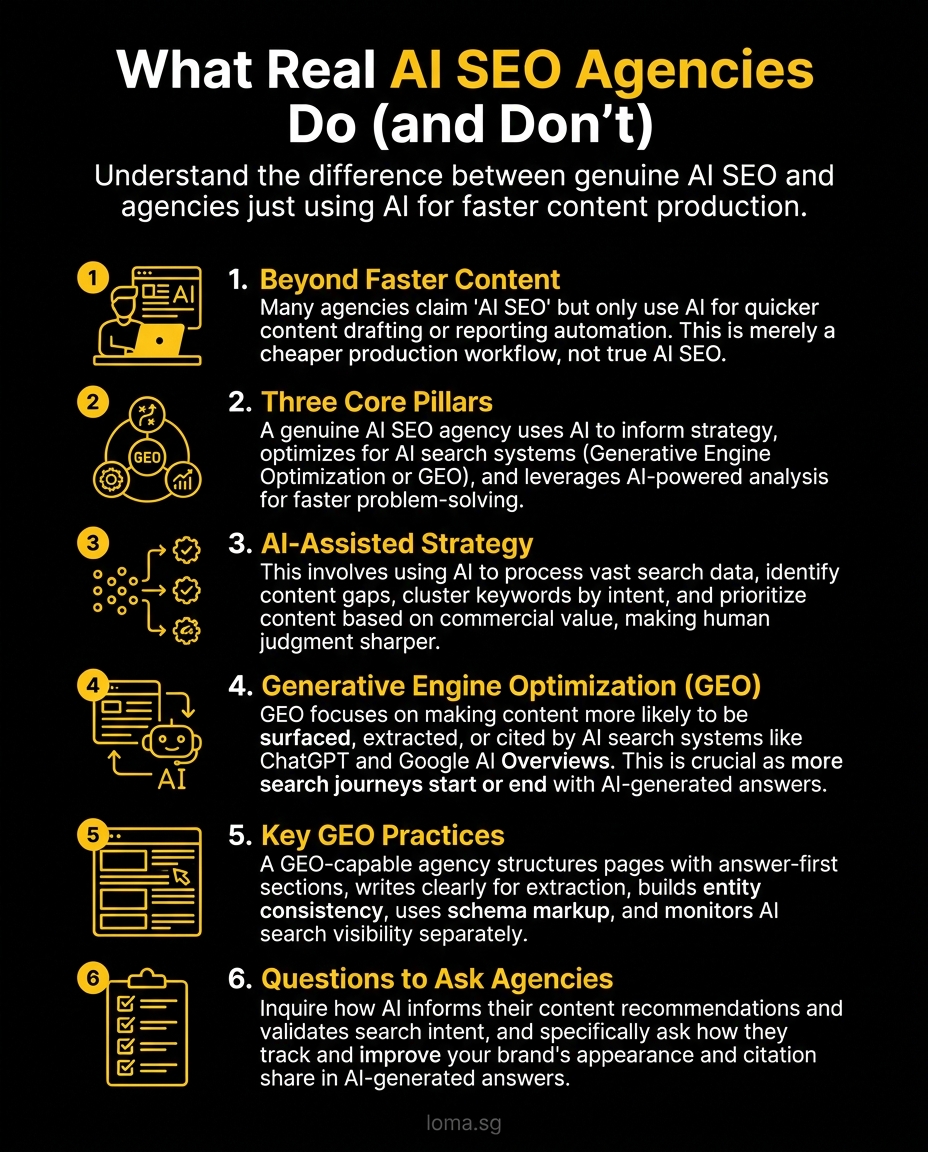
A real AI SEO agency does three things differently. First, it uses AI to inform strategy, not just speed up writing. Second, it optimises for AI search systems, not just Google's ten blue links. Third, it uses AI-powered analysis to spot problems and opportunities faster than a human-only workflow can.
That is the bar. Most agencies are nowhere near it.
Why Every Agency Is Suddenly an "AI SEO Agency"
Because the label is easy to claim and hard for buyers to audit.
An agency can open ChatGPT, ask for content ideas, generate a blog outline, and add "AI-powered" to its website by lunchtime. There is no certification. No standard. No minimum capability.
So what do many so-called AI SEO agencies actually do?
- They use AI to draft blog posts faster
- They summarise Ahrefs or Semrush exports with a chatbot
- They automate reporting decks
- They reduce labour time, then sell it back to you as innovation
None of that is useless. Faster production can help. Smarter reporting can help. But none of it justifies the label on its own.
If your agency's AI story starts and ends with content generation, you are not buying AI SEO. You are buying a cheaper production workflow.
That matters because the search market has changed in two directions at once.
Google still matters, obviously. But AI-generated answers now sit between the user and the click. Buyers increasingly research vendors through ChatGPT, Perplexity, and Google AI Overviews before they ever visit a homepage. At the same time, SEO has become too data-heavy and too fast-moving for slow, manual decision-making to be enough.
That is why the real conversation is not "does your agency use AI?" Every agency does, or will. The useful question is this: where does AI change strategy, execution, and diagnosis in a way your old agency could not deliver?
The answer should fall into three buckets:
- AI-assisted strategy
- GEO, or Generative Engine Optimization
- AI-powered campaign intelligence
If they cannot clearly explain all three, the label is probably cosmetic.
Part 1: AI-Assisted Strategy, the Baseline
This is the minimum standard, not the impressive part.
Real AI-assisted strategy means using AI systems to process more search data, content patterns, intent signals, and competitor coverage than a human strategist could do manually in a reasonable timeframe. The goal is not to replace judgment. The goal is to make judgment sharper.
A capable agency should be using AI to:
- Cluster keywords by intent, not just volume
- Identify content gaps across competitors and SERP leaders
- Compare what ranks with what converts
- Map topics to funnel stage
- Prioritise articles and landing pages based on commercial value, not traffic vanity
- Detect where your current site has topical weak spots or thin entity coverage
That is useful because most SEO waste comes from bad prioritisation, not bad writing.
Plenty of businesses publish content consistently and still get mediocre results. Why? Because they are writing the wrong articles, targeting broad queries with weak intent, or copying competitor topics after the market is already saturated.
AI can help compress the research cycle and surface patterns earlier. It can show where multiple queries really belong inside one stronger page. It can reveal when competitors dominate a topic cluster so completely that a different angle is smarter. It can help distinguish between content that attracts visitors and content that attracts buyers.
What AI-assisted strategy does not mean:
- Using ChatGPT to write articles faster
- Asking a chatbot for keyword ideas and calling it strategy
- Buying a tool with an AI badge and assuming that makes the agency sophisticated
Those are shortcuts, not a system.
If you are evaluating an agency, ask this:
How does AI inform which content you recommend, and how do you validate that against actual search intent?
A good agency will describe a process. It may mention specific tools. It should explain how recommendations are tested against real SERPs, query patterns, conversion goals, and business context.
A weak agency will say something vague like, "We use AI to identify high-opportunity keywords." That tells you almost nothing.
Another useful test: ask them to walk you through one content decision. Why did they prioritise topic A over topic B? Why is this page a blog post and not a service page? Why are they targeting this cluster now instead of next quarter?
If they cannot show how AI changed the recommendation, then AI is probably just decorating the pitch.
Part 2: GEO, the Part Most Agencies Are Missing
This is where the gap becomes obvious.
GEO, short for Generative Engine Optimization, is the discipline of making your content more likely to be surfaced, extracted, cited, or referenced by AI search systems. If you want the deeper version, read our guide to Generative Engine Optimization.
Why does this matter?
Because more search journeys now start or end inside an AI-generated answer. A buyer asks ChatGPT for the best CRM for a small business, the right SEO agency for a B2B brand, or the difference between two service models. Google AI Overviews may answer the question before the user clicks anything. Perplexity often cites a handful of pages and ignores the rest.
That changes what visibility means.
Ranking on page one is still valuable. But if your content is never cited, never extracted, and never used as a trusted source in AI-generated responses, you are missing the layer of search that many agencies still do not track properly.
A GEO-capable agency should understand how to:
- Structure pages with answer-first sections
- Write clearly enough for extraction without dumbing things down
- Build entity consistency across site pages, schema, and third-party mentions
- Use schema markup to clarify what a page, service, or organisation is about
- Create topic clusters that strengthen citation credibility
- Monitor AI search visibility separately from traditional rankings
This is not theory anymore. It is practical content design.
Pages that perform well in AI search tend to be specific, well-structured, direct, and semantically coherent. They answer the question early. They define terms cleanly. They use concrete examples. They avoid burying the useful bit under 500 words of throat clearing.
That last point is worth sitting with for a second. A lot of SEO copy was written for search engines that rewarded presence, not clarity. AI search systems reward clarity much more aggressively.
So when an agency says it does GEO, ask for proof.
Ask:
- Can you show where our brand appears in AI-generated answers for our target queries?
- How do you track AI citation share?
- What changes do you make to improve extraction and citation likelihood?
- What GEO practices are you running on your own site?
Most agencies cannot answer those questions well because most agencies have not operationalised GEO at all.
They may know the acronym. They may have read a post about AI Overviews. But that is different from building content workflows around answer structure, schema, citation footprint, and entity reinforcement.
At LOMA, GEO is not a side service we added because the acronym got popular. It is built into how we plan and structure content from the start. If a page ranks but never gets cited in AI search, we do not pretend that is the full job done. We treat it as incomplete visibility.
If you want to see the practical side of that, our AISEO and GEO service page explains how we approach it.
Part 3: AI-Powered Campaign Intelligence
This is the part clients usually feel first.
Most agency reporting is backward-looking and strangely unhelpful.
You get a PDF. A few keywords moved up. A few moved down. Traffic is up 11 percent or down 8 percent. There is a chart, a colour code, and maybe a sentence about seasonality. What you do not get is fast diagnosis.
That is the real weakness.
If your traffic dropped 30 percent tomorrow, would your agency catch it quickly? Would they know whether the cause was technical, competitive, algorithmic, content-related, or tracking-related? Would they tell you what matters first, or would you wait until the next monthly call?
Real AI-powered campaign intelligence should improve that turnaround.
Used properly, AI can help agencies:
- Detect anomalies early instead of waiting for month-end reporting
- Compare traffic changes against page groups, query categories, and conversion paths
- Spot which content cluster is slipping and why
- Flag internal linking gaps after new content goes live
- Prioritise recovery opportunities based on commercial impact
- Separate noise from actual signal during volatile periods
The point is not to replace analysts with a dashboard that hallucinates confidence.
The point is to reduce lag between change and action.
For most SMEs, that is the difference between a small ranking wobble and a quarter of preventable decline.
You do not need enterprise software with an absurd price tag to benefit from this. You need an agency that knows how to combine automation, interpretation, and business judgment.
That last part matters. Tools are easy to buy. Capability is harder.
A surprising number of agencies can list AI SEO tools. Far fewer can turn those tools into diagnosis you can actually use. A clever dashboard does not mean much if nobody can tell you why a service page stopped performing, whether the issue is content decay or SERP displacement, and what should be fixed this week.
So ask for a sample diagnostic.
Not a features page. Not a tech stack list. A diagnostic.
Ask them to explain how they would investigate:
- a sudden traffic drop
- a page that ranks but does not convert
- a content cluster that gets impressions but no clicks
- a brand that rarely appears in AI-generated answers despite strong rankings
That exercise exposes the difference between tool access and strategic competence very quickly.
The Questions That Separate Real AI SEO Agencies from Pretenders
If you are comparing agencies, these five questions will save you time.
1. Can you show me where my brand appears in AI-generated answers for my target queries?
If they do not track this, they are not serious about GEO yet.
2. How does AI inform your content prioritisation, and can you walk me through a specific decision?
You are looking for process, not slogans.
3. If my traffic dropped 30 percent tomorrow, how would you diagnose it, and what is your turnaround time?
A good agency has a triage method. A weak one has a reporting calendar.
4. What GEO strategies are you running on your own site?
If they are not testing these ideas on themselves, that is a bad sign. Agencies love selling innovation they have not operationalised internally.
5. Is AI search visibility tracked separately from Google rankings in your reporting?
It should be. They are related, but they are not the same thing.
You do not need your agency to sound futuristic. You need them to sound specific.
Specific beats trendy every time.
What LOMA's AI SEO Service Actually Includes
Fair question. If we are telling you how to audit the label, we should be able to answer the same checklist ourselves.
Here is what our AI SEO service includes:
- GEO built into content planning and content structure, not bolted on later
- Keyword and content strategy informed by AI-assisted intent analysis
- Reporting that looks at traditional search performance and AI search visibility together
- Faster anomaly detection, so problems are flagged within the week, not buried in a monthly slide deck
- Recommendations prioritised by pipeline contribution, not vanity traffic alone
- A practical engagement structure, including no lock-in beyond the initial three months
That does not mean AI does all the work. It means AI is used where it genuinely improves speed, pattern recognition, and decision quality, while humans still own judgment, positioning, and execution.
That is the right split.
An agency that promises fully automated SEO is selling fantasy. An agency that ignores AI entirely is selling yesterday.
The useful middle ground is AI-native strategy with human accountability.
The Bottom Line
The term "AI SEO agency" is getting diluted fast.
That was predictable.
Whenever a new category starts getting demand, the market fills with agencies claiming the label before they have earned it. The result is a lot of superficial positioning and very little operational difference.
So do not buy the phrase. Buy the process behind it.
A real AI SEO agency should be able to show you how AI improves strategy, how GEO is built into execution, and how campaign intelligence gets faster and sharper because of it. If they cannot show those things, then the AI label is mostly theatre.
If you want a team that treats SEO as both traditional search visibility and AI search visibility, talk to LOMA about AISEO and GEO. We will show you how we think, what we track, and where your current search strategy is probably leaving visibility on the table.