
If you are searching for an AI SEO agency Singapore brands can actually rely on, ignore the buzzwords for a minute and look at the work. Most agencies slapped “AI” onto their SEO package without changing the deliverables. Same ranking screenshots. Same blog factory. Same monthly report pretending position tracking is the whole story.
That is not enough anymore.
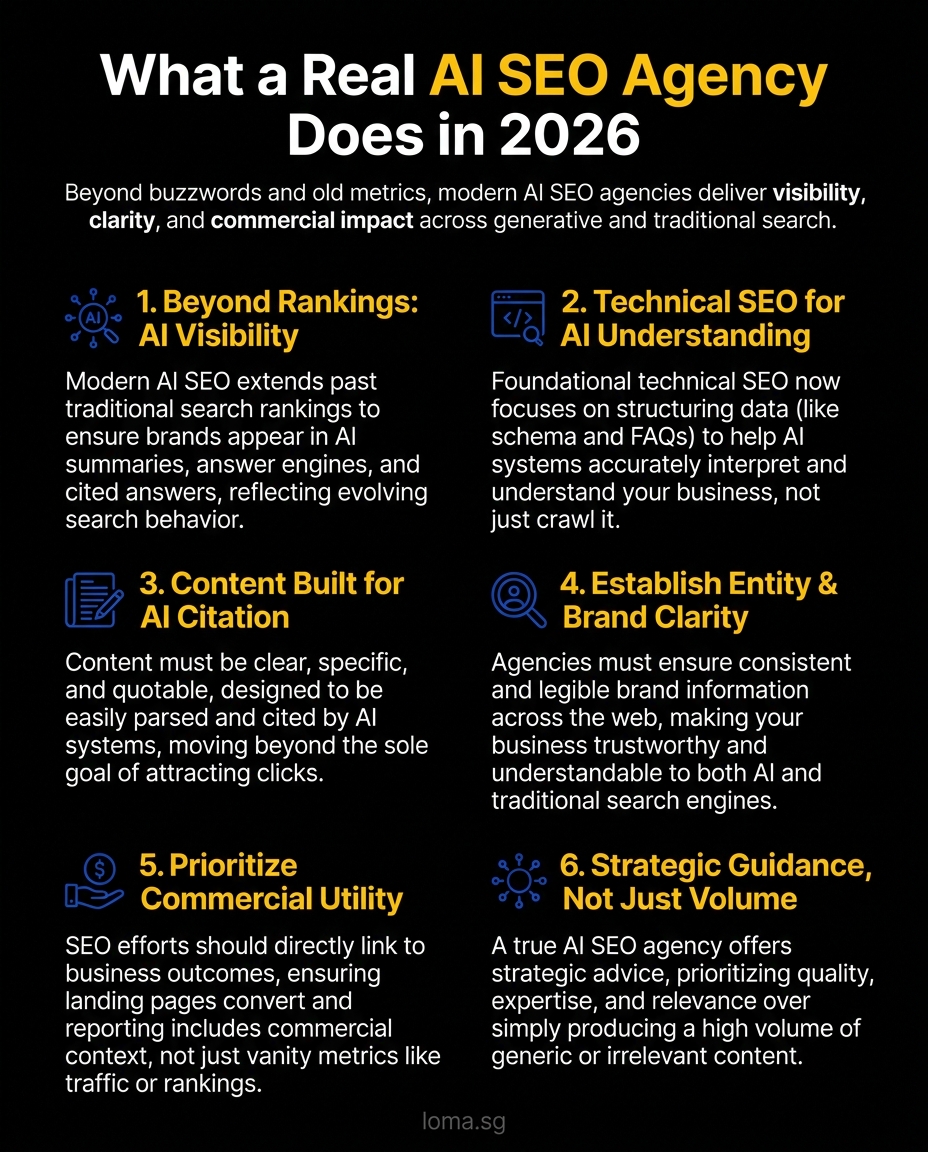
Search behaviour changed. Google now answers more queries directly. ChatGPT, Perplexity, and AI Overviews influence what buyers see before they ever click a blue link. The agency model has to change with that reality. A modern SEO partner should not just help you rank. It should help your brand become understandable, citeable, and commercially useful across both search engines and generative engines.
This is the line buyers need to draw in 2026. If an agency cannot explain how it handles AI search visibility, entity clarity, conversion paths, and reporting beyond vanity rankings, it is not an AI SEO agency. It is a traditional SEO agency wearing newer clothes.
Why the phrase “AI SEO agency” matters now
The term matters because the job changed.
Traditional SEO focused on crawling, indexing, rankings, traffic, and backlinks. Those still matter. Anyone telling you SEO is dead is either lazy or trying to sell you something shinier. But the output buyers care about is wider now. Your brand needs to show up in search results, in AI summaries, in cited answers, and on landing pages that actually convert when people arrive.
That means a real AI SEO agency should be doing two things at once.
First, it should still protect the fundamentals: technical SEO, site architecture, internal linking, content quality, and authority signals. Second, it should adapt those fundamentals for AI-era discovery. That includes structuring information clearly, building pages that answer specific commercial questions, strengthening entity signals around your brand, and tracking whether AI systems are surfacing your content in useful contexts.
A lot of agencies skip the second part because it is harder to package. Rankings are easy to screenshot. Citation visibility is messier. Entity work is less glamorous. Conversion-focused content requires actual thinking. But that is exactly why the phrase matters. It should separate agencies that understand what changed from agencies still billing for last decade’s checklist.
What most so-called AI SEO agencies are still selling
Here is the uncomfortable truth: most “AI SEO agency” offers are just traditional SEO with AI used internally to produce more stuff, faster.
That usually means:
- Keyword lists with no clear business priority
- Generic blog posts produced at volume
- Monthly reports built around ranking movement
- Backlink activity with weak relevance standards
- Little or no attention to AI Overviews, answer engines, or citation patterns
- Zero discussion of how landing pages convert after traffic arrives
Using AI to speed up writing does not make an agency AI-native. It just means the agency found a cheaper production method.
If the strategy is still “publish more top-of-funnel articles and wait,” you are not buying progress. You are subsidising content inflation.
A real AI SEO agency should be opinionated about what not to do. It should tell you that publishing thirty shallow articles is worse than publishing six pages with clear expertise, strong internal links, and a reason to exist. It should tell you that ranking for irrelevant informational terms is a distraction if those visits never become leads. It should tell you that reporting without commercial context is theatre.
That is the standard buyers should expect now.
The five capabilities that matter in 2026
The agencies worth hiring tend to share five capabilities. Miss one and the whole system gets weaker.
1. Technical SEO that removes friction, not just errors
Technical SEO still matters because AI systems and search engines both prefer clean, readable, reliable websites.
A proper agency should be looking at:
- Crawl efficiency and indexation issues
- Canonicals, redirects, and duplicate content
- Internal linking structure
- Core page speed bottlenecks
- Structured data and schema coverage
- Metadata quality and consistency
- Content rendering issues on JavaScript-heavy sites
This is not exciting work, but it is foundational. If your pages are messy, slow, duplicated, or poorly connected, everything on top gets weaker.
Where AI SEO changes the brief is in how technical work supports understanding. Schema markup, service definitions, FAQ structures, author clarity, and organisation details all help machines interpret your business with less guesswork. That is directly tied to generative engine optimization, not just traditional SEO hygiene.
If an agency says technical SEO is “done” after a one-time audit, be suspicious. On modern sites, technical work is not a setup task. It is maintenance.
2. Content built for citations, not just clicks
Most SEO content was designed around one outcome: get the click from search results.
That is no longer enough. In AI search, your content also needs to be worth citing before the click happens.
A strong AI SEO agency writes pages that are:
- Clear enough for machines to parse quickly
- Specific enough to be quotable
- Structured around real questions and decisions
- Rich in original framing, not recycled summaries
- Supported by internal links that reinforce topical depth
This is where weak agencies fall apart. They use AI to generate passable text, but passable text rarely gets cited. Citation-friendly content usually has sharp definitions, clean comparisons, strong sectioning, and genuine points of view.
For example, a page comparing traditional SEO with GEO SEO should not just define both terms. It should explain the commercial implication of each, where they overlap, and what a buyer should do differently because of that distinction. That is the kind of clarity answer engines pick up.
If an agency cannot explain how it creates content that works without relying on the click, it is not operating at the right level.
3. Entity and brand clarity that makes your company easier to trust
This is the part most agencies barely touch.
Entity work means making your business legible across the web. Search engines and AI systems need to understand who you are, what you do, what category you belong to, and which claims about your business are consistent enough to trust.
That includes:
- Consistent business descriptions across your site
- Clear service pages with distinct positioning
- About-page messaging that actually says something concrete
- Structured data that defines your organisation and offers
- Named proof points, case studies, and client context where appropriate
- Clean brand mentions across external properties
Why does this matter? Because AI systems are less likely to surface vague businesses. If your site says one thing, your social profiles say another, and your service pages are generic mush, you are hard to cite with confidence.
A modern SEO agency should care about entity clarity because it improves both discoverability and conversion. It is easier for search engines to understand your relevance, and easier for buyers to understand why you are different.
That is especially important for service businesses competing in crowded categories like digital marketing. If your positioning is generic, your SEO will be generic too.
4. Conversion-focused pages, because traffic without action is a vanity metric
This should be obvious, yet many agencies still treat conversion as someone else’s problem.
It is not.
An AI SEO agency should care what happens after the visit. If your content attracts the right audience but sends them to weak service pages, vague CTAs, or bloated forms, the campaign underperforms even if traffic looks healthy.
The job is not just to win impressions. It is to build pages that help buyers move.
That means the agency should be improving:
- Message match between keyword intent and landing page promise
- Offer clarity on service pages
- CTA placement and wording
- Trust signals such as proof, process, and objections handled well
- Internal paths from informational content to commercial pages
This is one of the biggest differences between an average SEO agency Singapore businesses often hire and a good one. Average agencies optimise for visibility. Good agencies optimise for visibility plus decision-making.
If your SEO partner never discusses conversion paths, it is essentially handing off half the value. That is lazy work dressed up as channel specialisation.
5. AI-era reporting that tells you what changed in the business
The old report stack is losing relevance.
Yes, rankings still matter. Yes, organic traffic still matters. But if those are the only numbers in your monthly review, the agency is showing you what is easiest to measure, not what matters most.
AI-era reporting should include a broader view:
- Which pages gained or lost visibility in organic search
- Which queries are driving commercial traffic, not just any traffic
- Whether branded and non-branded discovery is improving
- Which content earns external mentions or citations
- What percentage of organic entrances reach commercial pages
- Whether leads, enquiries, or qualified actions improved
- What changed structurally on the site, and why
In other words, reporting should explain movement, not just display it.
A strong agency should be able to say, “This service page gained traction because we clarified the offer, tightened internal links, and aligned the supporting articles around the same decision journey.” That is useful. A chart with seven keywords in green is not.
If an agency has no plan for AI search visibility measurement at all, that is an even bigger red flag. Nobody has perfect reporting for answer engines yet, but serious agencies are at least building practical proxies and monitoring patterns. Pretending the shift is irrelevant is not a strategy.
Red flags to watch for when evaluating an agency
If you are comparing vendors, these warning signs should move an agency down the list quickly.
Red flag 1: They talk about AI as a production shortcut, not a search behaviour shift
If the pitch is mostly about using AI to create content faster, you are hearing an operations improvement, not a strategy.
You should care far more about how the agency responds to changing discovery patterns than how fast it can generate drafts.
Red flag 2: Their reporting is obsessed with rankings and silent on conversions
Ranking reports are not worthless. They are just incomplete.
If the agency cannot connect SEO work to page quality, lead quality, or commercial intent, it is probably hiding behind familiar metrics.
Red flag 3: Their blog strategy is volume-first and insight-light
You can spot this quickly. The article titles are generic. The intros sound interchangeable. The advice is broad enough to apply to every industry and useful to none.
That content might fill a calendar, but it will not build authority.
Red flag 4: They have no position on AI Overviews, ChatGPT, or Perplexity visibility
You do not need a magic dashboard. You do need a plan.
A serious agency should be able to explain how it thinks about citation-worthy content, entity reinforcement, structured information, and search intent shifts caused by AI summaries.
If the answer is “we focus on Google only,” that is not prudence. It is inertia.
Red flag 5: They treat service pages like brochure copy
Brochure copy does not rank well, and it does not convert well.
Your service pages should target clear intent, answer real objections, and link naturally from supporting content. If those pages read like they were approved by nine committees and designed to offend nobody, expect weak outcomes.
What to ask before you hire an AI SEO agency
Use these questions in the sales call.
- How does your SEO strategy account for AI search and answer engines?
- What do you measure beyond rankings and traffic?
- How do you decide which content deserves to be created at all?
- What is your process for improving service pages, not just blog posts?
- How do you strengthen brand and entity clarity across the site?
- What technical SEO work is ongoing after the initial audit?
- Can you show how SEO work influenced leads or pipeline, not just visits?
A good agency will answer directly. A weak one will drift into jargon.
That is usually the moment the room tells on itself.
When to hire, and what a modern partner should look like
Hire an agency when you need more than execution capacity. Hire one when you need judgment.
That means you want a team that can prioritise the right pages, challenge weak assumptions, tighten your technical setup, build content with citation value, and connect search visibility to revenue opportunities.
That is how we approach AISEO at LOMA. We do not treat AI search as a side topic and we do not pretend old SEO reporting is enough. We build for both search engines and generative engines, with the technical foundation, content structure, and commercial thinking required to make that work.
If you want an SEO partner that still sends ranking screenshots and calls it strategy, there are plenty of options. If you want a team that understands how discovery actually works in 2026, start with our AISEO services, explore our web development work, or talk to LOMA about where your current setup is falling short.