
Most content about B2B lead generation reads like it was written for a US audience and then had "Singapore" added in the title. The advice isn't wrong exactly. It's just incomplete. Singapore's B2B market has structural realities that change which channels work, how fast they work, and how much they cost to run. This post is an honest map of B2B lead generation in Singapore for founders and marketing leads who are tired of tactics that look good on paper but don't fill their pipeline.
Why B2B Lead Generation Here is Harder Than the Playbooks Say
Singapore is a small market. That sounds obvious but the implications compound. Your total addressable market for almost any B2B category tops out at a few thousand companies. There are roughly 280,000 SMEs in Singapore, but if you're selling HR software, logistics tech, or B2B consulting with a minimum deal size above $20k, you're looking at a few hundred to a few thousand realistic prospects.
In a market that small, buying decisions run through relationships. Decision committees are real even in 30-person companies. Sales cycles for anything meaningful run 3 to 12 months. A cold lead from LinkedIn Ads who's never heard of you will take far longer to close than a referral from someone who trusts you.
This doesn't mean digital channels don't work. It means they work differently here. Volume metrics that matter in large markets (traffic, impressions, click-through rates) are proxies, not outcomes. What matters is getting in front of the right 50 decision-makers repeatedly and earning their trust before they're ready to buy.
The Channel Map: What Each One Actually Delivers
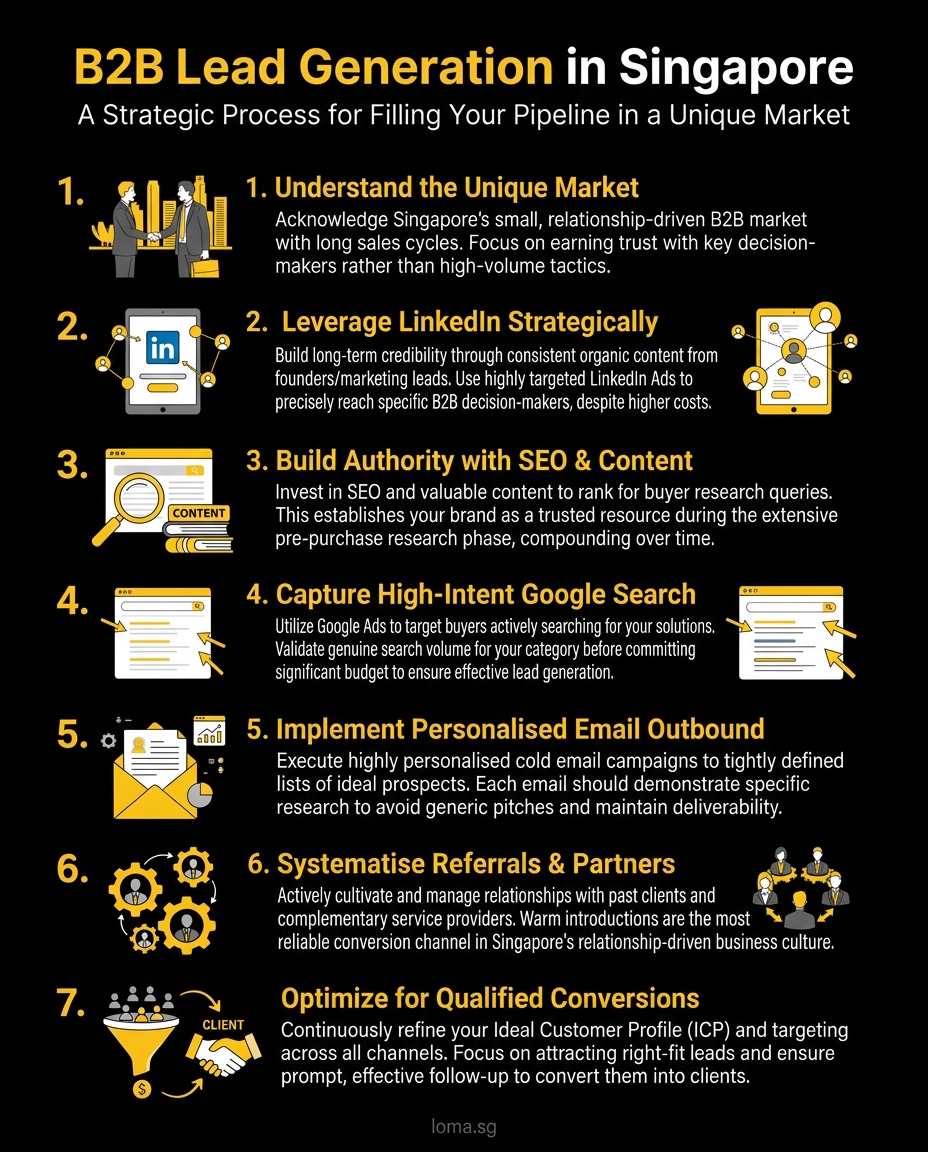
Here's an honest breakdown of five B2B lead generation channels. Not ranked by "best" - sequenced by where they fit in the funnel and what kind of results they actually produce.
LinkedIn (Organic + Ads)
LinkedIn is where B2B decision-makers in Singapore spend professional time. For most B2B categories, it's the only social platform that reliably reaches them.
Organic LinkedIn: Building a genuine LinkedIn presence takes 6 to 12 months but compounds. A founder or head of marketing posting consistently about real problems they solve builds credibility with buyers who'll remember you when they're ready. The mistake most companies make is posting company news nobody cares about instead of content that actually helps the audience.
LinkedIn Ads: Expensive but high-targeting precision. You can reach Finance Directors at logistics companies with $10M+ revenue in Singapore specifically. CPCs typically run $8 to $25 depending on the audience - budget $3,000 to $5,000 per month minimum to get meaningful data. Best for: professional services, SaaS, B2B consulting where the deal size justifies the cost per lead.
Watch out for: broad targeting (job title "Manager" includes warehouse supervisors, not just people with budget authority). Narrow your audience even if it shrinks reach.
SEO and Content
The compounding channel. B2B buyers in Singapore research extensively before any conversation, often for months. If you're not ranking for the informational queries they're asking ("how to choose HR software Singapore", "logistics outsourcing Singapore pros cons"), you're invisible during the most important part of their buying journey.
SEO takes 6 to 12 months to produce meaningful traffic. For categories with genuine search volume (HR software, accounting solutions, logistics, fintech), the ROI over 24 months typically outperforms paid channels. For categories without search volume (buyers don't know your solution exists yet), SEO won't generate much directly but still builds domain authority that makes your other channels work better.
The SEO vs SEM trade-offs are worth understanding before allocating budget. Content that earns backlinks and positions you as the category authority does double duty: it generates organic traffic and warms up buyers who encounter you through other channels.
Google Ads (Search)
High intent, high cost, high ceiling for the right categories.
Google Search Ads work when buyers are actively searching for what you sell. "Accounting software Singapore," "B2B freight Singapore," "HR outsourcing provider Singapore" - these searches signal active purchase consideration. CPCs for commercial B2B terms in Singapore typically run $5 to $30 depending on category competitiveness.
The constraint: Google Ads don't work if your buyers aren't searching for your category yet. If you're selling something new or your buyers think of their problem differently than you frame your solution, search campaigns will generate low volume or off-target clicks. Run a few weeks of exact-match campaigns first to validate that your buyers are actually searching before committing budget.
Email Outbound
Underused in Singapore and misunderstood.
Most B2B founders either dismiss cold email ("spam") or use it badly (generic sequences sent to purchased lists). Done right, personalised cold email to a tightly defined list of 200 to 500 ideal prospects works, particularly for niche verticals like legal tech, logistics, or healthcare services where you know exactly who the decision-maker is.
Done wrong, it damages your domain reputation, gets your email flagged, and poisons your deliverability for all outbound communication. The bar: every email should be specific enough that the recipient believes you actually researched them. One good line of personalisation beats five sentences of generic pitch.
Referral and Partner Networks
The most reliable closed-deal channel in Singapore. By a significant margin.
Singapore's business culture is relationship-driven. A warm introduction converts at 5 to 10 times the rate of cold outreach, not because Singaporeans are uniquely different but because B2B trust takes time to build and referrals compress that timeline. The buyer already has risk transferred to someone they trust.
Most companies treat referrals as a bonus that happens when it happens. That's leaving your best channel to chance. Building a referral system means: identifying the 20 people most likely to send you business (past clients, strategic partners, complementary service providers), staying in contact with them deliberately, making it easy for them to refer (a clear brief on who your ideal client is, a simple intro email they can forward), and thanking referrals with something meaningful.
Partner networks go one level further: formal arrangements with complementary providers who regularly cross-refer. For a digital marketing agency, that might be a web developer, an accounting firm, or a business consultant who works with growth-stage SMEs.
The Conversion Problem: Why Leads Don't Become Clients
Even when leads come in, B2B pipelines leak in predictable places.
Wrong-fit leads: Your targeting is too broad. You're getting marketing managers with no budget authority when you need CFOs. Fix: tighten your ICP (ideal customer profile), update your ad targeting, and audit which channels are sending the most qualified leads, not the most leads.
Slow follow-up: A lead that fills out a form and doesn't hear back within 24 hours loses temperature fast. B2B buyers are often evaluating two or three providers simultaneously. If you're the slowest to respond, you lose the shortlist position before the conversation starts. A CRM with task automation is table stakes, not a nice-to-have.
Weak nurture: B2B sales cycles are 3 to 12 months. Most companies run a few follow-up emails and then move on. The buyers who downloaded your guide in January are often ready to talk in July, but by then you've forgotten about them. Build email sequences and content that keep you front-of-mind over a 6-month period. This is where content marketing as a long game pays off.
The website is often where leads go to die. A well-run ad or organic content piece brings someone in, and then a vague homepage or an undifferentiated "Contact Us" CTA sends them back out. Why your site isn't converting is often the highest-leverage fix in a B2B lead generation system before adding more spend to any channel.
Building a B2B Lead Generation System
A tactic generates one lead. A system generates leads predictably.
The difference: a system has components that work together and reinforce each other. Here's what it looks like in practice.
Content that earns trust during the research phase. Two to four pieces of genuinely useful content per month, optimised for the searches your buyers actually make. Not content for its own sake. Content that answers the real questions they're asking before they're ready to talk.
SEO that captures high-intent searches. Every category has a set of searches that indicate active buying intent. Own as many of those as you can. LinkedIn marketing for SMEs and SEO compound together when you repurpose blog content into LinkedIn posts that drive traffic back to your site.
LinkedIn presence that warms up decision-makers. The goal isn't to go viral. It's to show up in the feed of your 200 best prospects regularly enough that when they have a problem you solve, you're already in their mental shortlist.
A clear CTA that moves someone from interested to in conversation. Most B2B websites make buyers work too hard to take the next step. One clear, specific CTA beats a homepage with five options. "Book a 30-minute call to review your current lead generation setup" converts better than "Get in touch."
A CRM that ensures no lead falls through the gaps. Not optional. If you're tracking leads in a spreadsheet or worse, in someone's inbox, you're losing deals you'd otherwise close.
This is what a B2B lead generation system looks like. Most companies have two or three of these pieces but not all five working together.
Build the System Before Adding Budget to Channels
The default move when lead generation isn't working is to spend more on ads. This is usually the wrong move. More spend into a leaky system produces more waste, not more clients.
The right order: fix your ICP, fix your website conversion, establish one content channel, build your referral network, then scale paid spend once you know the fundamentals are working.
LOMA builds B2B lead generation systems for Singapore brands - from content strategy and SEO to paid campaigns and website conversion. Tell us where your pipeline is leaking. Talk to LOMA about your lead generation.