
Q1 is done. If you're an SME owner reviewing your marketing spend right now, asking yourself whether the budget mix you set in January is actually working, you're not alone.
Most SME marketing budgets in Singapore were built on a model designed for 2022: allocate by channel. 30% SEO, 30% paid ads, 20% social, 20% content. Hire separate vendors for each. Measure impressions and clicks.
That model is outdated. AI tools have collapsed what used to require three vendors into one integrated stack. A GEO-optimised blog post compounds traffic for years. An AI assistant can do the work of a junior copywriter at S$50/month. If your budget allocation hasn't changed since 2022, you're probably over-spending on some things and completely missing others.
This is a practical guide. Real S$ numbers, honest trade-offs, and a framework built for where marketing actually is in 2026.
Why the Old Budget Model Is Broken
The old model divided your budget by channel because that's how agencies were structured. You paid one vendor for SEO, another for Google Ads, another for social media management. Each vendor reported on their own metrics. Nobody owned the full picture.
Here's what that looked like with a S$3,000/month budget in 2022:
- S$900 to an SEO agency (mostly technical audits and backlinks)
- S$900 to a Google Ads manager (who kept the account fees even when performance dropped)
- S$600 to a social media manager (mostly graphics and scheduling)
- S$600 to a content writer (1-2 blog posts per month)
Total output: modest organic growth, fragile paid traffic, and four separate invoices.
The same S$3,000/month in 2026 can get you:
- A modern SEO + GEO programme that covers AI search citations
- AI-assisted content production at 3x the volume
- Automated ad optimisation via AI tools
- A unified performance dashboard you actually understand
The difference: AI tools have compressed the cost of execution. What you should be budgeting for now is strategy, quality, and the right tool stack, not headcount.
The right unit of measurement is no longer "how much per channel." It's "how much per outcome, at each stage of the business."
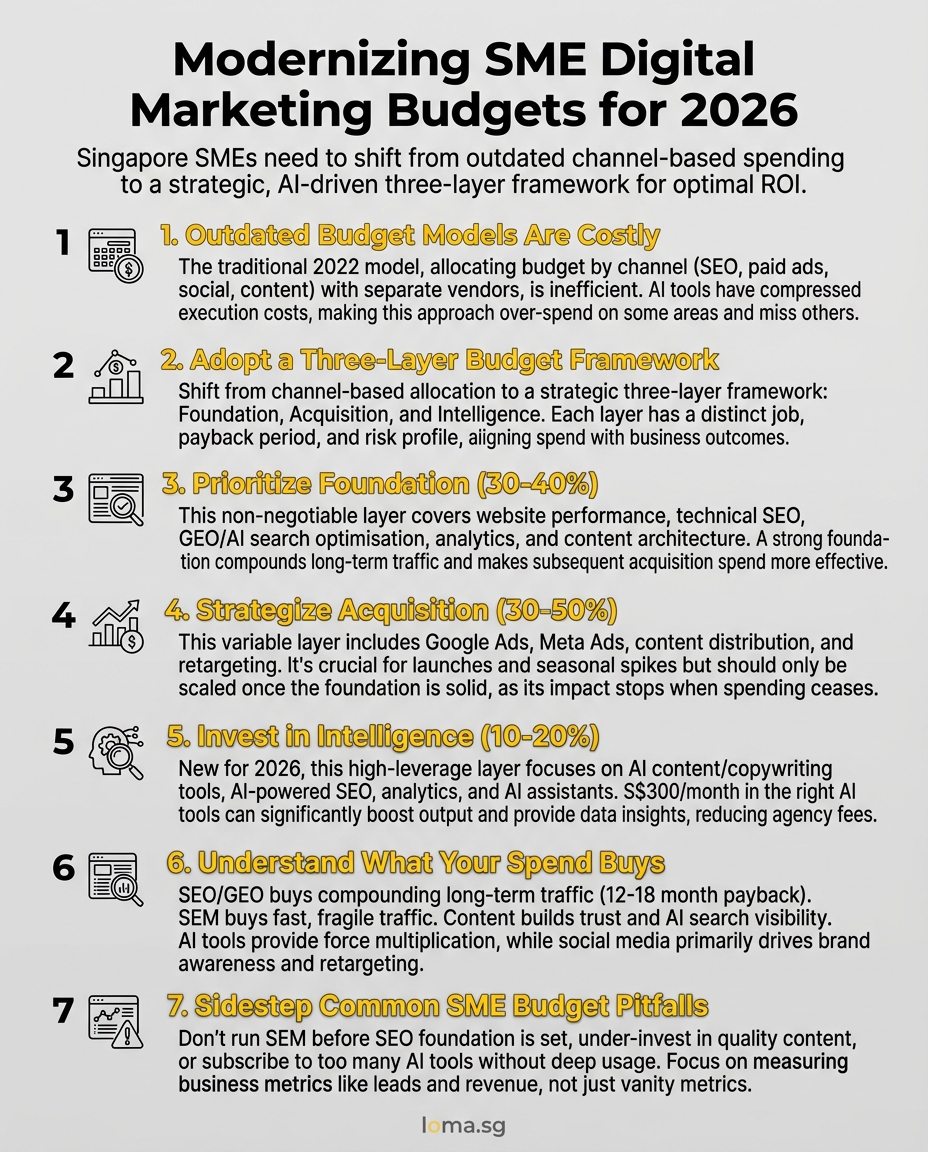
The Three-Layer Budget Framework
Think of your marketing budget in three layers, not five channels. Each layer has a different job, a different payback period, and a different risk profile.
Layer 1: Foundation (Non-Negotiable)
This is what every business needs before any acquisition spend makes sense. Foundation investment compounds over time. It's the floor that everything else stands on.
What it covers:
- Website performance and technical SEO
- GEO and AI search optimisation
- Analytics and conversion tracking
- Content architecture (blog structure, topic clusters, internal linking)
Budget share: 30-40% of total marketing spend
If your foundation is weak, every S$1 you put into paid ads is more expensive than it needs to be. You're paying for clicks that land on a site that can't convert, or can't rank for the searches that matter.
Layer 2: Acquisition (Variable by Stage)
This is where most SMEs over-invest too early. SEM, social ads, influencer: these channels work, but only once you have something worth driving traffic to.
What it covers:
- Google Ads and Meta Ads
- Content distribution (LinkedIn, email)
- Retargeting
- Seasonal or launch campaigns
Budget share: 30-50% of total marketing spend (lower early-stage, higher when scaling)
The honest trade-off: acquisition spend stops the moment you stop paying. It's essential for launches and seasonal spikes. It's not a substitute for organic growth.
Layer 3: Intelligence (New in 2026)
This is the layer that didn't exist three years ago. AI tools have changed the math on marketing output, and most SMEs are either not using them at all, or paying for tools they don't know how to use.
What it covers:
- AI content and copywriting tools (S$200-500/month)
- AI-powered SEO and keyword research
- Marketing analytics and attribution tools
- AI assistants integrated into your website or CRM
Budget share: 10-20% of total marketing spend
This is also the highest-impact layer. S$300/month in the right AI tools can 2x content output, reduce agency fees, and surface data insights that used to require a dedicated analyst.
What Each Dollar Is Actually Buying
Let's be specific. Here's what different parts of your budget are actually purchasing.
SEO and GEO: You're buying compounding long-term traffic. The payback period is real: expect 12-18 months before significant organic gains. The 3-year return is why this is a non-negotiable investment, not a discretionary one. GEO (optimisation for AI search tools like ChatGPT and Perplexity) is now part of this layer. If your content isn't structured for AI citations, you're invisible to a growing share of search traffic.
SEM (Google Ads): You're buying fast, fragile traffic. It works immediately. It stops the moment you pause the campaign. Essential for product launches, seasonal spikes, and markets where organic competition is too high to wait for. Not a substitute for SEO.
Content: You're buying trust and AI search visibility. Google's own guidance ties ranking to content quality. AI search tools cite authoritative, well-structured content. A blog post written in 2026 with strong GEO structure can drive traffic for years. One that's thin or generic will never surface in AI search results.
AI tools: You're buying force multiplication. S$200-500/month for a properly used AI stack can 2x the output of your content, halve briefing time, and give you data-driven recommendations that would have cost S$5,000 in an agency audit. The catch: tools don't work without the right processes around them.
Social media: You're primarily buying brand awareness and retargeting fuel. For most B2B SMEs, social is not a primary acquisition channel. It warms leads, keeps you visible to people already in your funnel, and builds credibility. Don't expect direct revenue attribution from organic social posts.
Common Budget Mistakes SMEs Make
1. Running SEM before SEO foundation is set
This is the most expensive mistake. If your website has no tracking, weak landing pages, or no clear conversion goal, every click you pay for is wasted. Set up your foundation first.
2. Under-investing in content
SEO without content is like a shop with no products. Google, AI search tools, and buyers all need content to decide whether you're worth talking to. One blog post per quarter is not a content strategy.
3. Buying too many tools before using any of them
The AI tools market in 2026 is overwhelming. Most SMEs subscribe to 5-8 tools and actively use 2. Consolidate. Get one tool and use it deeply before adding another. The ROI is in mastery, not subscriptions.
4. Measuring vanity metrics
Impressions, followers, page views: these are activity metrics, not business metrics. The right things to measure are leads generated, cost per lead, pipeline contribution, and revenue attributed to marketing. If your marketing agency reports clicks but can't tell you what happened after the click, that's a problem.
5. Treating the budget as fixed by channel
If SEM is burning cash and SEO is gaining traction, reallocate. Quarterly budget reviews should be the norm, not annual ones. Your marketing mix should evolve with your results.
Budget Allocation Examples by Business Type
Here are three concrete examples. These are starting points, not formulas. Every business has a different competitive context.
S$3,000/month: Service-Based SME, Building Organic Presence
| Layer | Allocation | S$ Amount |
|---|---|---|
| Foundation (SEO, GEO, content) | 55% | S$1,650 |
| Acquisition (light SEM for brand terms) | 25% | S$750 |
| Intelligence (AI tools, analytics) | 20% | S$600 |
This business is early-stage, prioritising long-term compounding over short-term paid volume. SEM is limited to brand protection and high-intent keywords. The goal is organic traction within 12 months.
S$7,000/month: eCommerce Brand, Acquisition + Retention
| Layer | Allocation | S$ Amount |
|---|---|---|
| Foundation (SEO, product content, GEO) | 30% | S$2,100 |
| Acquisition (Meta Ads, Google Shopping, email) | 50% | S$3,500 |
| Intelligence (AI tools, personalisation) | 20% | S$1,400 |
eCommerce needs acquisition volume, but organic search and email retention reduce dependence on paid channels over time. AI personalisation tools start to show ROI at this budget level.
S$12,000/month: B2B Company, Long Sales Cycle
| Layer | Allocation | S$ Amount |
|---|---|---|
| Foundation (SEO, content, thought leadership) | 40% | S$4,800 |
| Acquisition (LinkedIn Ads, SEM, events) | 40% | S$4,800 |
| Intelligence (CRM integration, attribution, AI) | 20% | S$2,400 |
B2B with a 30+ day sales cycle needs to build authority and stay visible throughout a long consideration period. SEO and content drive organic demand. LinkedIn Ads target decision-makers. Attribution tools are essential to understand which touchpoints are driving pipeline.
How LOMA Approaches Budget Planning
Most agencies pitch you a channel package. LOMA starts with where you are in the growth stage and works backward to what your budget should be doing.
AI tools are built into every LOMA retainer, not billed as add-ons. Our content workflow uses AI to increase output without sacrificing quality. Our SEO work includes GEO from day one, so your content is optimised for both Google and AI search tools.
We measure pipeline contribution, not impressions. If we can't connect marketing activity to leads and revenue, we restructure until we can.
If you're looking at your Q1 results and wondering whether your budget is working as hard as it should, book a free 30-minute budget review call with LOMA. We'll map your current spend against your growth stage and tell you honestly where to reallocate.
No pitch. Just the numbers.