
A growing number of B2B buyers in Singapore are not starting with a search results page. They are opening ChatGPT, Gemini, Perplexity, or Google AI Overviews and asking a blunt question: who are the right vendors for this problem?
That changes vendor discovery fast. It also changes what SEO needs to do.
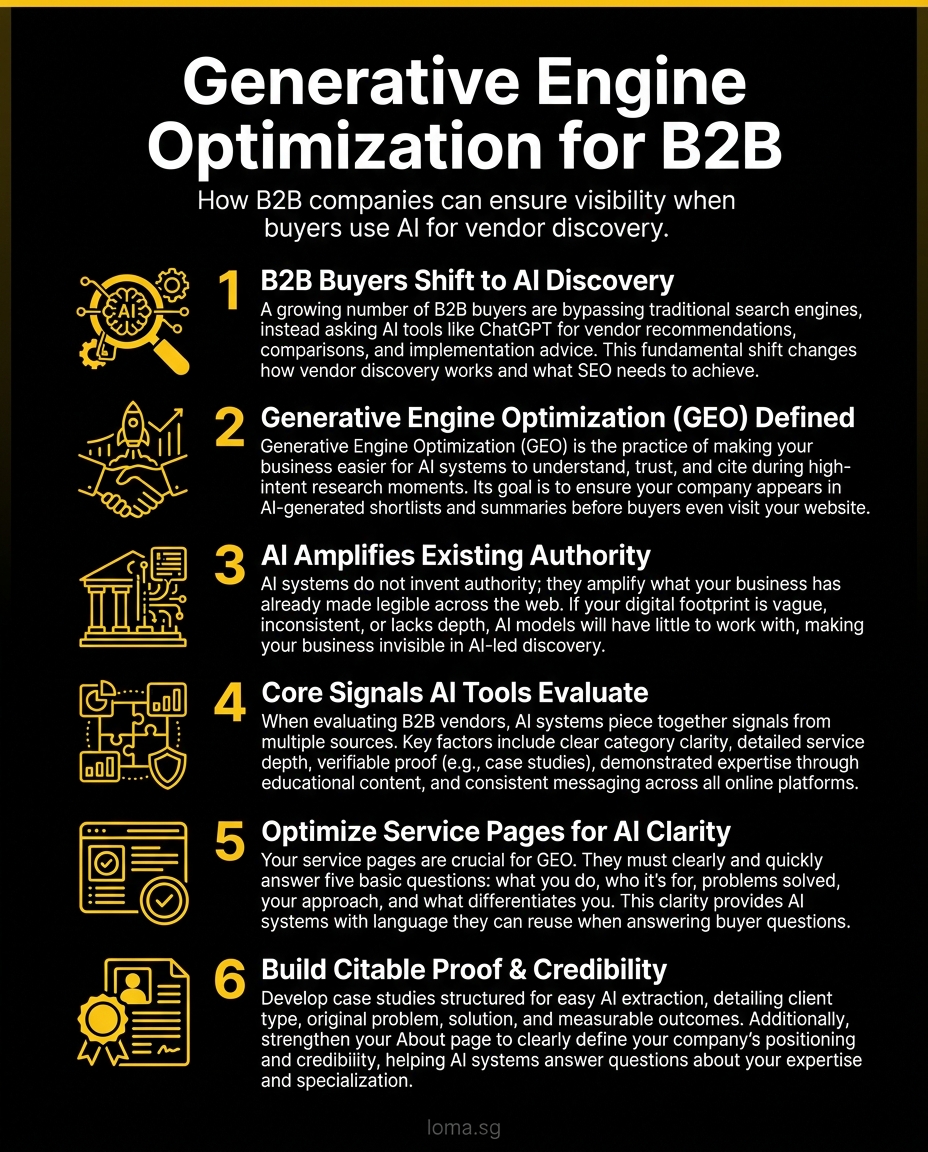
If your company wants to appear when buyers ask AI for recommendations, comparisons, or implementation advice, you need more than rankings. You need generative engine optimization, or GEO. The goal is simple: make your business easier for AI systems to understand, trust, and cite during high-intent research moments.
For B2B teams, this matters earlier than most people think. Buyers can now ask AI to shortlist agencies, summarise service differences, compare implementation approaches, and filter out weak options before they ever visit your site. If you are not visible in that layer, you are missing the shortlist before the sales conversation even starts.
Why B2B buyer journeys are changing
B2B buying has always involved long research cycles, multiple stakeholders, and too many tabs open at once. AI compresses that process.
A marketing lead can now ask:
- Which AI SEO agencies are credible for B2B companies?
- What should we look for in a GEO SEO partner?
- Which firms have actual implementation depth, not recycled SEO messaging?
- What are the risks of hiring a generalist agency for AI search optimisation?
Those are not casual questions. They are commercial questions. They happen close to evaluation, not just awareness.
This is where many businesses get the problem wrong. They assume AI visibility is about chasing mentions inside AI tools. It is not. AI systems need source material. They pull from pages, profiles, citations, proof points, and structured signals across the web. If your digital footprint is vague, inconsistent, or thin, the model has very little to work with.
In other words, AI does not invent authority for you. It amplifies what your business has already made legible.
What AI tools look for when evaluating B2B vendors
When a buyer asks AI for vendor recommendations, the system is usually piecing together signals from multiple sources. The mechanics vary by platform, but the pattern is consistent. Strong B2B vendors tend to be easier to categorise, easier to verify, and easier to explain.
Here are the core signals that matter most.
1. Category clarity
If your homepage says you do "growth, innovation, transformation, and strategy," that sounds polished and says almost nothing.
AI systems need clear category labels. They should be able to tell what you do, who you do it for, and where your depth sits. If you are an AI SEO agency, say it plainly. If you specialise in B2B lead generation, say that too. Ambiguity makes AI hesitate.
This is why your main service pages matter so much. A well-built service page on AISEO / GEO gives AI systems language they can reuse when answering buyer questions.
2. Service depth
Thin pages do not survive serious evaluation.
A buyer asking AI for vendors is not just looking for a list of names. They want to know whether those vendors actually understand the work. That means your site needs detail on process, scope, deliverables, use cases, and points of differentiation.
A vague 400-word service page is not enough. Neither is a page stuffed with buzzwords and stock icons. Depth signals competence.
3. Proof
B2B buyers are sceptical, and they should be. AI tools reflect that. They are more likely to surface businesses with evidence: case studies, implementation examples, named capabilities, and consistent claims backed by real pages.
Proof does not always mean giant logos. It means specificity. What did you build? What changed? What problem did you solve? For whom?
If your site talks about outcomes in generalities, AI has nothing solid to repeat.
4. Expertise
Educational content matters because it shows whether your company can explain the space clearly.
This is one reason blog content is still useful, even in an AI-first discovery model. A focused article on generative engine optimization, a practical guide on AI search visibility, or a strong point of view on vendor evaluation can all help AI systems connect your brand to the topic.
But not all content helps. Commodity posts do very little. If your article says the same thing as every other agency blog, you are training the model to ignore you.
5. Consistency across the web
Your website, company profiles, LinkedIn presence, citations, and thought leadership should tell the same story.
If your site says you are a specialist B2B AI SEO agency but your external profiles barely mention it, that weakens confidence. AI systems look for pattern alignment. Consistency is not glamorous, but it is one of the easiest trust signals to strengthen.
A practical generative engine optimization framework for B2B companies
Most B2B firms do not need a giant GEO overhaul. They need a tighter system. Start with the parts of your digital presence that AI buyers rely on during vendor evaluation.
Step 1. Fix your service-page language
Your service pages should answer five basic questions fast:
- What do you do?
- Who is it for?
- What problems do you solve?
- How do you approach the work?
- Why are you different from generic alternatives?
That sounds obvious. It is also where many B2B sites fall apart.
A proper GEO-ready service page needs category clarity and commercial specificity. If you offer AI-driven search strategy, explain the mechanics. If you improve discoverability in AI search experiences, say how. If your approach combines technical SEO, entity clarity, topical authority, and conversion intent, spell it out.
Do not hide the useful language because you want to sound clever.
Step 2. Build case studies that are actually citable
Many case studies are unusable. They are either too shallow or too self-congratulatory.
For AI discovery, the best B2B case studies are structured so a system can extract the essentials quickly:
- client type or sector
- original problem
- solution delivered
- implementation details
- measurable changes or concrete operational outcomes
If confidentiality limits what you can name, you can still be specific. "B2B SaaS company" is better than nothing. "Regional industrial supplier" is better than "a valued client."
This is a real difference between standard content marketing and GEO SEO. The goal is not only persuasion for human readers. It is extractability. Your proof has to be easy to cite.
Step 3. Strengthen your About page
B2B buyers do not just evaluate services. They evaluate credibility.
Your About page should help AI systems answer questions like:
- What kind of company is this?
- What are they known for?
- What makes their perspective credible?
- Are they specialists or broad generalists?
A good About page does not ramble through company history. It sharpens positioning. For AI-led vendor research, that matters more than most teams realise.
Step 4. Publish educational content tied to buying questions
This is where many content strategies waste time. They chase informational traffic with no clear link to commercial discovery.
For B2B GEO, your content should map to questions buyers ask during evaluation, such as:
- how to choose an AI SEO agency
- what makes a vendor credible in AI search
- how to get cited in AI search
- GEO SEO vs traditional SEO for B2B demand generation
- what proof buyers should expect from an implementation partner
These topics do two jobs. They build topical authority, and they give AI systems structured explanations they can reuse when responding to research prompts.
If your content library is disconnected from buying-stage questions, it may generate traffic but fail to influence shortlist formation.
Step 5. Align external signals
Do not treat your site as the whole story.
Your LinkedIn page, founder profiles, media mentions, listings, and partner references all add context. AI systems do not only read your homepage and call it a day. They infer credibility from the pattern.
This is where weak positioning creates drag. If one source says you are a web agency, another says performance marketer, and another says AI consultancy, you are making yourself harder to recommend.
Pick the right category story and repeat it consistently.
Why generic SEO retainers often miss the point
This is where B2B firms waste time with the wrong partner.
A generic SEO retainer is usually built to chase rankings across a broad keyword set, publish predictable blog content, and report on traffic growth. That can still help in some cases, but it is not the same as improving AI-led shortlist visibility.
When buyers ask AI for vendor recommendations, the real question is not whether your site ranks for one article. It is whether your company reads as a credible answer. That requires tighter service positioning, stronger proof, clearer entity signals, and content built around evaluation-stage questions, not just top-of-funnel traffic.
If an agency cannot explain that difference, they are probably selling old SEO packaging with new AI wording. B2B firms should be careful with that.
What B2B teams usually get wrong
There are a few recurring mistakes.
Treating GEO as a technical trick
Some teams hunt for loopholes. They want a checklist that forces AI tools to mention them.
That mindset is a dead end. Generative engine optimization is not a prompt hack. It is a visibility strategy built on clearer information architecture, better proof, and stronger topic authority.
Publishing content with no commercial usefulness
If your blog is full of generic thought pieces that never answer buyer questions, it will not help much. You need content that reflects actual evaluation behaviour.
A buyer does not care that "AI is transforming marketing." They care whether your firm knows enough to solve their problem and whether that expertise is visible across the web.
Saying too little on core pages
B2B teams often over-design and under-explain. Clean pages are fine. Thin pages are not.
If AI cannot understand what makes your offer credible, buyers may never see you in the first place.
Failing to connect visibility with conversion intent
Being cited is not enough. You want the right kind of traffic, from buyers with the right problem, landing on pages that continue the conversation.
That is why GEO should connect to service architecture, proof, and CTA flow. Visibility without commercial fit is just a nicer version of vanity.
How to tell if your company is ready for generative engine optimization
You are ready if any of these sound familiar:
- buyers increasingly mention ChatGPT or AI Overviews during research
- your brand has expertise, but your site explains it poorly
- you rank for some terms but are not clearly positioned in AI-led discovery
- your content gets traffic but weak lead quality
- competitors with sharper positioning feel easier to recommend
The uncomfortable truth is that B2B vendor discovery is becoming more narrative-driven. AI systems synthesise who you are, what you do, and why you are credible. If your digital presence does not support that story, stronger competitors will fill the gap.
The real opportunity
This shift is not bad news for B2B firms. It is a filter.
Buyers are using AI to reduce noise. Businesses with clearer positioning, better proof, and more useful content will benefit. The firms that relied on vague branding and generic SEO copy will struggle.
That is why generative engine optimization matters now. It sits at the intersection of discoverability and recommendation. Not just whether you can be found, but whether you make sense as an answer.
If your team wants to improve how buyers encounter your brand during AI-led research, LOMA can help you build an AISEO strategy that strengthens visibility, clarifies positioning, and drives better-fit leads. If you want the broader system aligned, from content to conversion paths, explore our work in digital marketing or get in touch via contact.