
Generative engine optimization is becoming a real commercial advantage for service businesses in Singapore, not because AI search is trendy, but because buyers are starting to trust summarised recommendations before they click through to a website.
That changes the game.
If you sell expertise, strategy, implementation, or advisory work, you are not competing for a product listing. You are competing to be understood, trusted, and named as a credible option inside an AI-generated answer. That is a different job from traditional SEO.
A lot of GEO SEO advice is still written like it is meant for publishers chasing traffic. Service businesses need a more practical lens. You do not need endless listicles. You need a site that makes your positioning obvious, your services easy to interpret, and your proof hard to ignore.
What generative engine optimization means for service businesses
Generative engine optimization is the process of making your business easier for AI systems to interpret, trust, and recommend in tools like ChatGPT, Perplexity, Google AI Overviews, and other AI-driven search experiences.
For service businesses, the goal is not just ranking for a blue link. The goal is showing up when someone asks a high-intent question such as:
- Which SEO agency should I consider for a B2B company?
- Who offers AI SEO services for service businesses?
- What are some credible digital agencies for lead generation?
When AI search answers those questions, it tends to favour businesses that look clear, consistent, and proven. If your site is vague, thin, or stuffed with generic agency language, you get filtered out fast.
This is why service firms win or lose differently in AI search.
An eCommerce site can rely on product feeds, reviews, and pricing data. A service business often has to earn visibility through narrative clarity. AI systems need to understand what you do, who you do it for, what outcomes you help create, and why your business deserves to be cited.
That is also why many agencies will struggle here. Their sites say everything and nothing at the same time. "Full-service." "Results-driven." "Innovative solutions." It reads like agency wallpaper. AI models do not need hype. They need evidence and structure.
The five signals AI systems look for when recommending a service provider
If you want to get cited in AI search, focus on the signals that make your business legible.
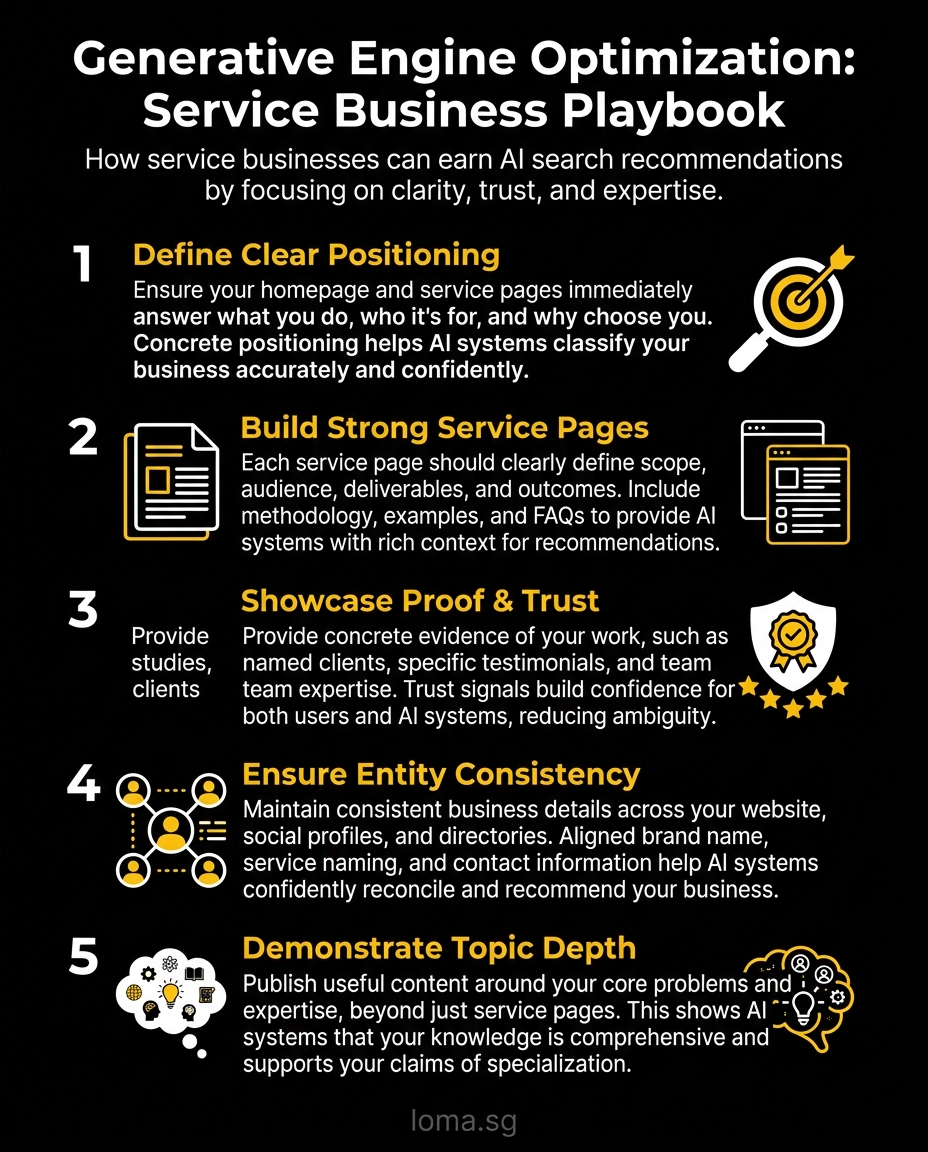
1. Clear positioning
Your homepage and service pages should answer three questions within seconds:
- What do you do?
- Who is it for?
- Why choose you instead of a generic alternative?
Most service businesses bury this under brand slogans and soft messaging. That is a mistake.
If you run an agency, consultancy, law firm, design studio, or software services company, your positioning should be concrete. "AISEO strategy for service brands that want better visibility in AI search" is far more useful than "we help brands grow online."
Clear positioning helps humans decide faster, and it helps AI systems classify your business with less guesswork.
2. Strong service pages
Your service pages do most of the heavy lifting in generative engine optimization.
Each service page should make the scope, audience, deliverables, and commercial intent obvious. If a page is too broad, too short, or too abstract, it becomes difficult for AI systems to map it to a recommendation.
A strong service page usually includes:
- A specific service definition
- The type of client or use case it fits
- Your approach or methodology
- Outcomes the service aims to improve
- Supporting proof, examples, or FAQs
This is one reason we push businesses to build proper expertise pages instead of hiding everything behind a single services overview. A page like AISEO / GEO gives AI search far more context than a vague all-in-one services page.
3. Proof and trust signals
AI-generated answers often reflect consensus and confidence. That means trust signals matter more than ever.
If your site makes big claims with no proof, you are asking both users and AI systems to take a blind leap.
Useful trust signals include:
- Case studies with concrete context
- Named clients or sectors served
- Testimonials that say something specific
- Author or team expertise
- Clear company information on your About page
- Contact and business legitimacy signals on your site
You do not need a glossy trophy cabinet. You do need enough substance to show that your business exists in the real world and has done this work before.
4. Entity consistency
Entity consistency sounds technical, but the idea is simple. Your business details should line up across your website and the wider web.
That includes:
- Brand name
- Service naming
- Founder or leadership information
- Social profiles
- Directory mentions
- Contact details
- Descriptions of what your company does
If your homepage says one thing, LinkedIn says another, and your directories say something else again, you create ambiguity. AI systems are far less confident recommending a business they cannot reconcile cleanly.
This is where many brands quietly lose ground. Not because the business is weak, but because the entity is messy.
5. Topic depth
A service business does not need a bloated blog. It does need topic depth around the problems it wants to be known for.
If you want to be recommended for AI SEO work, publish useful content around generative engine optimization, AI search visibility, citation patterns, service-page optimisation, and search behaviour shifts. That creates context.
Topic depth tells AI systems your expertise is not a one-page claim. It is a recurring theme supported by your content, service pages, and strategic point of view.
Done well, this is where blog content supports lead generation instead of just filling a calendar.
A practical GEO checklist for service businesses
If your goal is to improve how often your business gets surfaced in AI-generated answers, start with the pages that shape your commercial narrative.
Homepage: fix the positioning first
Your homepage should not try to say everything.
It should clearly frame your category, audience, and angle. If you are an agency, say what kind. If you are a specialist consultancy, say what problem you solve. If you have an AI angle, explain what that means in plain English.
Check your homepage for these issues:
- Headline is clever but unclear
- Services are listed without clear differentiation
- No explanation of who the business is for
- Weak proof above the fold
- No internal paths into deeper service pages
A homepage should act like a confident introduction, not a personality test.
Expertise pages: stop being generic
Your service pages are where recommendation quality is won.
For each major service, ask:
- Does this page explain the service in practical terms?
- Does it show who should buy it?
- Does it include proof, examples, or FAQs?
- Does it link to relevant supporting content?
- Would an outsider understand what makes this offer different?
If the answer is no, fix the page.
For many businesses, this is the highest-impact GEO task available. Strong expertise pages improve both search visibility and conversion quality. That is a rare double win.
If your offer spans SEO, content, paid media, and web work, separate them clearly. A page like Digital Marketing can support broader discovery, but it should still route users and AI systems toward more specific areas of expertise.
About page: make the business easy to trust
The About page is often treated like a brand vanity piece. It should do more.
This page helps AI systems confirm who you are, what you believe, and why your business has authority in its space. It is also where real buyers look when they are deciding whether your positioning is credible.
A useful About page includes:
- What the company does
- Why it exists
- Who leads it
- What kind of clients it works with
- How it thinks about its work
Do not waste this page on empty mission talk. Substance beats sentiment.
Blog: build depth, not content clutter
Your blog should support your service lines, not drift into random marketing commentary.
If you want better visibility in AI search, publish content that helps AI systems and buyers understand the problem space around your offer.
Good topics include:
- How AI search changes vendor discovery
- What strong service pages look like
- How to build authority signals into your site
- What buyers ask before hiring an agency or consultant
- Where traditional SEO still matters, and where it does not
The standard to use is simple: if a buyer asked an AI tool about this topic, would your article deserve to inform the answer?
If not, skip it.
What to stop doing if you want to get cited in AI search
A few habits are especially damaging for service brands.
Stop writing like every other agency
If your copy could belong to 500 other businesses, it is too generic. AI systems do not reward sameness. They compress it.
Stop relying on one thin services page
Broad services pages are useful for navigation, not depth. If you want recommendation visibility, you need stronger destination pages.
Stop publishing filler content
A weak article does not help your authority. It just adds noise. Ten sharp pieces aligned to your expertise beat fifty forgettable posts.
Stop separating SEO from conversion
This is the part too many teams miss.
Getting mentioned in AI search is only half the job. The page still needs to convert. If your site earns attention but does not build confidence, the traffic quality will not matter.
The best generative engine optimization work connects discoverability with commercial clarity.
When to handle GEO internally, and when to bring in outside help
If you already have strong messaging, clear service pages, and a capable internal content team, you can handle a lot of GEO SEO work in-house. Start by tightening positioning, upgrading your expertise pages, and publishing a focused content cluster around your core services.
But if your site still has fuzzy positioning, weak service architecture, and generic content, internal teams usually move too slowly because they are trying to fix strategy, copy, structure, and SEO at the same time.
That is where outside support helps.
A good AISEO partner should not just chase citations or talk about prompt visibility. They should help you build a site that is easier to recommend and easier to buy from.
That means clearer service narratives, stronger entity signals, better content depth, and tighter alignment between AI search visibility and conversion intent.
If that is the gap you need to close, explore LOMA's AISEO / GEO service. We help businesses build search visibility for the AI era without turning their site into a jargon museum.