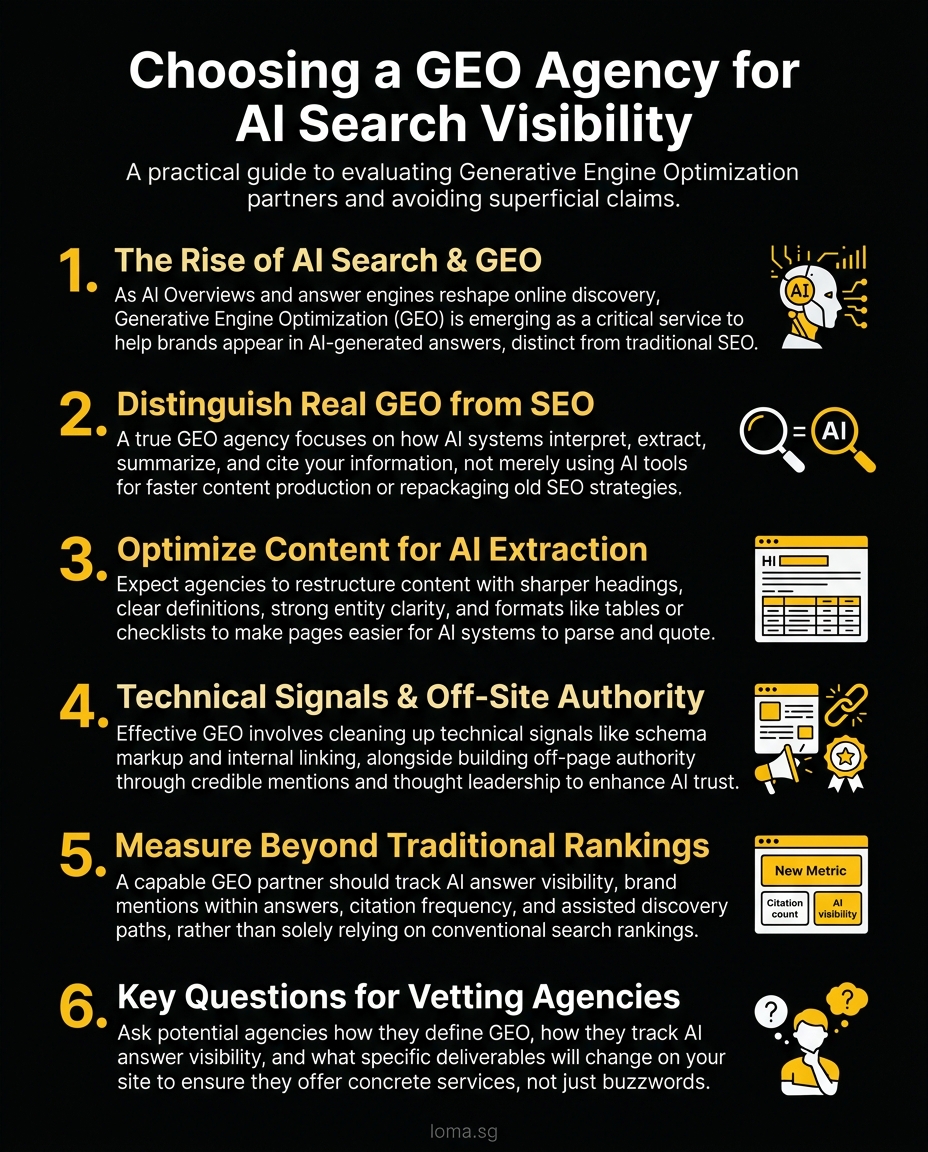
Anyone can call themselves a GEO agency in Singapore now. That is the problem.
As AI Overviews, ChatGPT, Perplexity, and other answer engines reshape how people discover brands, agency positioning is getting noisy fast. Some firms are doing real generative engine optimization work. Others are taking their existing SEO package, adding three letters to the proposal, and hoping nobody asks follow-up questions.
If you are comparing partners, you do not need another beginner explainer on what GEO is. You need a buying framework. You need to know what a real GEO agency should actually change, how progress should be measured, and which red flags usually signal expensive fluff.
This guide is that framework.
Why GEO agency claims are about to explode
Agency categories expand the moment buyer demand becomes obvious. GEO has reached that point.
Business owners can already see AI-generated answers showing up in places that used to be dominated by blue links. Search is no longer just a ranking game. It is also a citation game, an extractability game, and an entity clarity game. That creates a new budget line item, or at least a new question inside the existing SEO budget.
The problem is that many buyers still evaluate GEO agencies using old SEO signals alone. That is not enough.
A strong SEO foundation still matters. If an agency cannot handle technical hygiene, content strategy, or authority building, it will not suddenly become brilliant at GEO. But GEO is not just SEO with ChatGPT sprinkled on top. It requires an agency to think beyond ranking positions and ask a different set of questions:
- Which queries trigger AI-generated answers?
- Which sources get cited repeatedly?
- Which page structures are easiest for answer engines to extract?
- Which entities, claims, and trust signals make a brand more likely to be referenced?
- Which changes improve visibility across multiple answer surfaces, not just Google Search Console impressions?
That difference matters. An agency that only talks about AI prompts, AI-written blogs, or publishing more articles faster is usually selling a costume, not a capability.
What a real GEO agency should actually do
A real GEO agency should be able to describe work in plain English. Not philosophy. Not trend commentary. Work.
1. Research the answer surfaces, not just the keyword list
Traditional keyword research still matters, but it is only the starting point. GEO work begins by mapping where AI-generated answers appear, which queries trigger them, and what kinds of sources are consistently referenced.
That means looking at:
- Google AI Overviews
- ChatGPT responses for commercial and informational queries
- Perplexity answer patterns
- Branded versus non-branded query behaviour
- Citation frequency by page type, format, and domain authority
If an agency cannot explain how it studies answer surfaces, it probably is not doing GEO in any serious way.
2. Restructure content for extraction and citation
A lot of websites are readable to humans but messy for machines. Long fluffy intros, vague headings, buried definitions, weak entity signals, and unclear page purpose all make extraction harder.
A GEO agency should improve:
- Heading hierarchy
- Direct answer blocks
- Comparison sections and summaries
- Entity clarity, including who you are, what you do, who you serve, and how your offer differs
- Supporting evidence such as examples, FAQs, specs, and policy details
The goal is not to write for robots. The goal is to make useful content easier to parse, quote, and trust.
This is also where good GEO overlaps with good on-page SEO. If you want the broader foundation, see LOMA's digital marketing services and blog for related thinking.
3. Clean up technical structure and machine readability
Answer engines cannot cite what they cannot interpret cleanly.
A real GEO agency should look at schema, internal linking, canonical consistency, page metadata, crawlability, duplicate content issues, image alt text, and whether key pages communicate clear entities and relationships.
This does not mean schema alone will make you appear in AI answers. It will not. But weak technical structure makes every other content and authority effort less effective.
If an agency treats technical work as optional, that is a warning sign.
4. Build authority signals beyond your own website
Citation eligibility is not created on your site alone. Third-party mentions, reputable links, press references, industry citations, and consistent brand signals all help answer engines determine whether your site is worth referencing.
That is why GEO cannot be reduced to content production volume.
A credible agency should talk about off-page authority, brand mentions, and the wider evidence graph around your company. If they only promise more blog posts, they are solving half the problem at best.
5. Measure more than rankings
This is where bluffing agencies often fall apart.
Rankings still matter, but GEO reporting should also cover:
- Presence in AI-generated answer environments
- Citation frequency and source inclusion
- Share of answer visibility for target topics
- Changes in branded search demand
- Organic traffic quality to prioritised pages
- Lead quality from pages designed for answer-surface discovery
If the reporting model is just “we will send you a ranking report every month,” that is not a GEO reporting model. That is an SEO template with a fresh label.
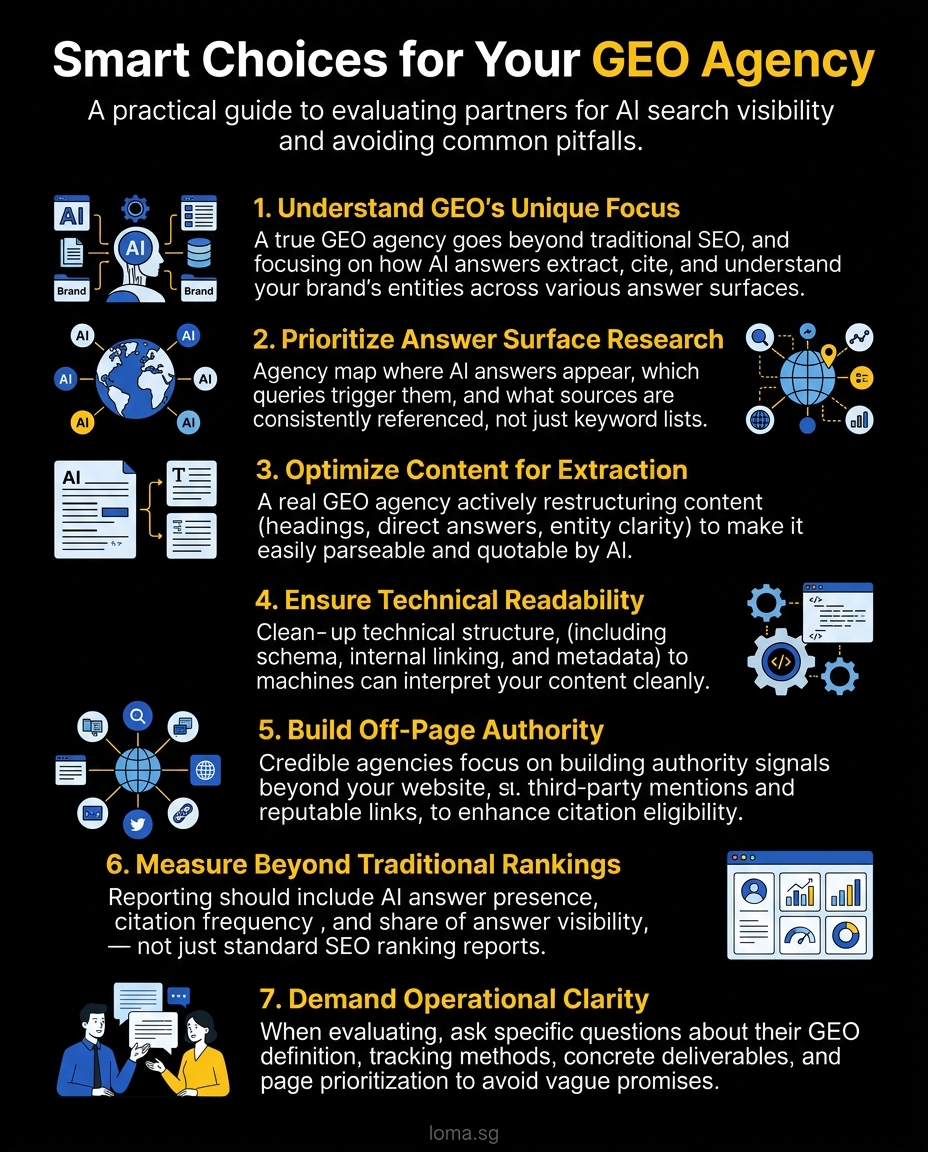
The 7 questions to ask before you hire a GEO agency
If you are evaluating partners, ask these seven questions. A competent agency should answer directly. If the response turns fuzzy, you have your answer.
1. How do you define GEO in your process?
Start here because it reveals everything else.
A weak answer sounds like this: “We use AI to improve your SEO.” That says almost nothing.
A strong answer should explain how the agency approaches visibility in AI-generated answers, how that differs from standard SEO, and where the overlap still exists. You are looking for operational clarity, not buzzwords.
2. How do you track AI answer visibility today?
This question forces the agency to talk about measurement.
You want to hear something concrete about query sampling, answer-surface checks, citation monitoring, page-level observation, and limitations in current tooling. Honest nuance is a good sign. GEO measurement is still maturing. Pretending it is perfectly solved is usually a sales move.
3. What specific deliverables change on my site?
This is a very useful question because it cuts through theatre.
Ask what they will actually change in the first 30 to 60 days. Good answers might include content restructuring, schema cleanup, FAQ or comparison modules, page rewrites, entity reinforcement, internal linking updates, and authority-focused content planning.
If the deliverables sound like “ongoing optimisation” with no specifics, push harder.
4. How do you decide which pages to optimise first?
Not every page deserves GEO effort first.
The agency should be able to prioritise pages based on commercial value, current authority, query patterns, answer-surface potential, and where your brand already has a chance to be cited. Smart prioritisation matters because GEO is not a spray-and-pray exercise.
5. What third-party signals or citations matter in my category?
A serious GEO agency thinks beyond your CMS.
If you are in B2B services, healthcare, eCommerce, or another category with trust sensitivity, the agency should have a view on the publications, directories, comparison sites, communities, and external references that influence discoverability and credibility.
If they act as if nothing outside your site matters, that is a miss.
6. How do you report progress when rankings are not the only KPI?
This question tests whether the agency has adapted its reporting mindset.
A good answer should include both traditional SEO indicators and GEO-specific proxies. It should also acknowledge that some gains show up first as better inclusion, better citation quality, or stronger assisted discovery before they show up as a neat ranking movement.
In other words, you want an agency that understands the scoreboard changed, even if the old scoreboard still exists.
7. What GEO work are you doing on your own site?
This question is slightly uncomfortable, which is exactly why it is useful.
If an agency sells GEO services, its own site should show evidence of structured thinking, strong entity clarity, useful answer-ready content, and visible positioning around AI search. That does not mean it must dominate every query. It does mean it should practice what it is selling.
For example, LOMA treats GEO as part of a broader AISEO service, not a trendy bolt-on. That matters because standalone buzzwords rarely survive contact with real execution.
Red flags that signal the agency is bluffing
A few warning signs appear again and again.
They obsess over prompts instead of pages
Prompt experimentation has its place for research. It is not the core service.
If an agency spends most of its pitch talking about prompt engineering rather than site structure, authority, content clarity, and measurement, it is probably dressing up experimentation as strategy.
They cannot explain measurement
No agency can measure every answer environment perfectly yet. Fair enough.
But if they cannot explain any practical framework for tracking visibility, citations, inclusion, or answer-surface changes, they are flying blind.
They treat GEO as blog volume
More articles do not automatically mean more AI visibility.
Content matters, but random publishing cadence is not a strategy. Good GEO content is structured around extractable answers, clear entities, useful comparisons, and topical authority. Volume without structure is just more clutter.
They have no view on off-page trust signals
If the agency acts like GEO lives entirely inside your website, it is missing how answer engines evaluate credibility. Mentions, references, links, and external validation still matter.
They force local context unnaturally
This one is subtle, but revealing.
If every paragraph clumsily repeats local modifiers to chase traditional SEO patterns, the agency may be writing for a checklist instead of for clarity. Good localisation is precise. Bad localisation is repetitive and obvious.
They cannot show what changes after the audit
A lot of agencies are good at decks. Fewer are good at implementation.
Ask what happens after diagnosis. Which pages get rewritten? Which templates get updated? Which schema gets fixed? Which internal links change? Which authority gaps get addressed? If those answers are weak, the service probably is too.
How LOMA approaches GEO for growing brands
We think the best GEO work sits inside a broader AISEO strategy.
That means we do not treat answer-engine visibility as a magic trick. We treat it as the result of three things working together:
- Strong query and intent research
- Clean, extractable, technically sound content structures
- Credible authority signals on and off your site
That approach is more useful than selling a mystery box called “AI visibility.”
We also think buyer education matters. A brand should understand what is changing on its site, why those changes were prioritised, and how progress is being evaluated. If an agency needs to stay vague to sound impressive, it is probably not that impressive.
If your team is comparing options, use the seven questions above. They will save you time, budget, and one very irritating six-month retainer.
And if you want a partner that treats GEO like a real operating discipline, not a trend badge, talk to LOMA about AISEO and GEO strategy. We help brands improve visibility where AI-generated answers are actually shaping discovery, not just where old reporting templates feel comfortable.