
Most agencies will tell you what you want to hear. Here's how to find out what you need to know before you sign.
Every SME founder who's been burned by an agency says the same thing in hindsight: "The signs were there. I just didn't know what to look for."
The pitch was confident. The deck was polished. The case studies looked impressive. Six months later, the results were vague, the reporting was confusing, and the account manager who sold you in had quietly handed over to a junior exec you'd never met.
This post is a pre-mortem for that situation. Not a generic checklist of "look for experience and good communication", a specific guide to the questions that separate agencies that do the work from those that sell the dream.
Why Most SME Agency Relationships Fail Before They Start
The problem usually isn't the agency doing something wrong. It's the wrong expectations from day one.
Four patterns show up constantly:
The brief is too vague. "Improve our social media" is not a brief. It tells an agency nothing about what success looks like for your business. Agencies that don't push back on this early are either too eager to close or too inexperienced to know what they'd need.
The evaluation is based on the pitch, not the work. Sales teams are often the best people in the agency. The delivery team is different. A sharp pitch does not predict sharp execution.
The contract locks you in before you see real performance. A 12-month retainer signed after one meeting is a significant commitment to an unknown quantity. Agencies that require this upfront are usually protecting their own cash flow, not your interests.
The timeline is misaligned from the start. Agencies selling "results in three months" for SEO are either lying or counting on you not knowing enough to call it out. Organic SEO takes six to twelve months to compound. Any agency that doesn't tell you this early is optimising for the close, not the relationship.
Understanding these failure patterns changes how you evaluate agencies. You stop listening to claims and start watching for behaviour.
Eight Questions to Ask Before You Sign
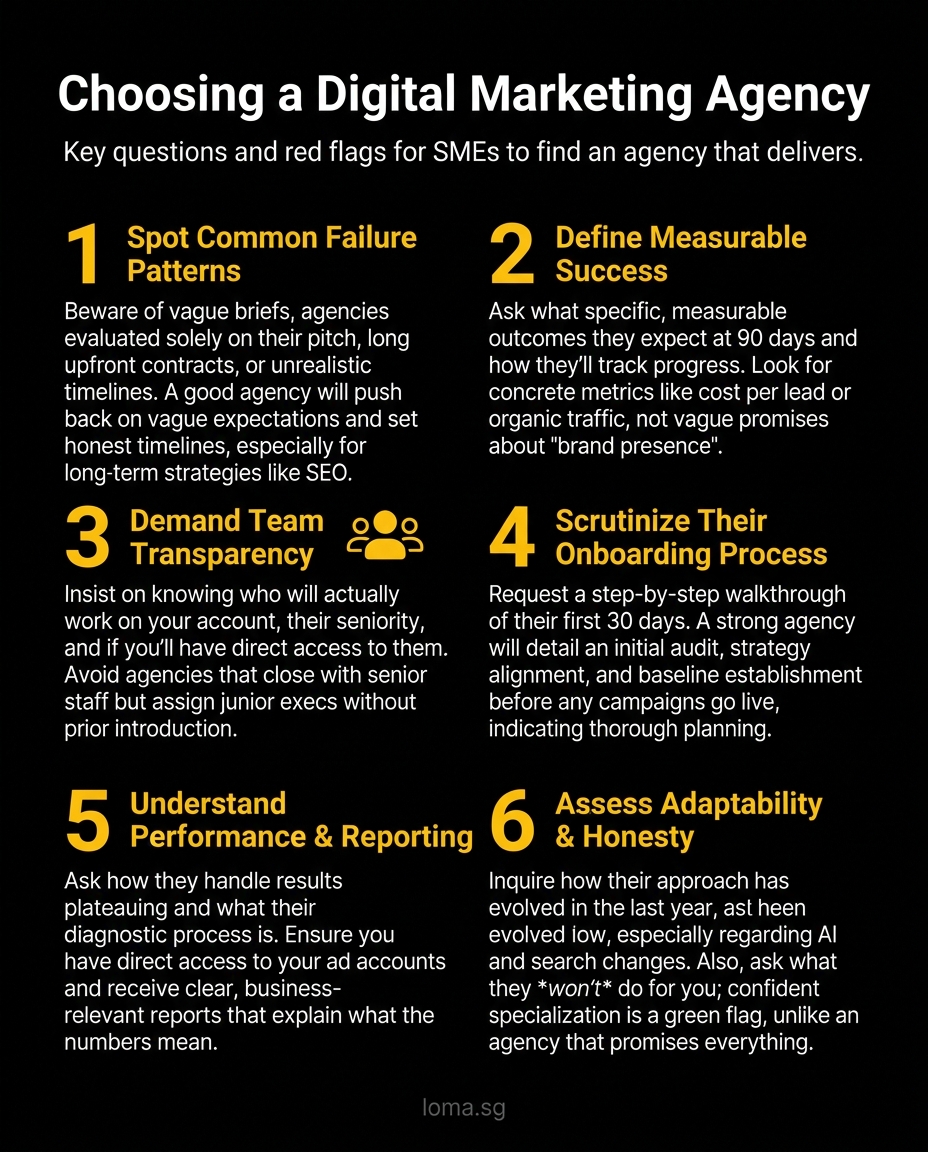
These aren't gotcha questions. They're diagnostic questions, the kind that reveal how an agency actually thinks about client work. A strong agency will answer them directly and specifically. A weak agency will give you generalities.
1. "What does success look like at 90 days, and how will we measure it?"
This is the single most revealing question you can ask. Vague answers, "we'll improve your brand presence" or "increase your digital footprint", tell you the agency hasn't thought clearly about what they'll actually deliver. Strong answers name specific metrics: cost per lead, organic traffic to target pages, conversion rate on a specific campaign.
You're not looking for guaranteed numbers. You're looking for whether they can articulate what they'd be aiming at and how they'd know if they hit it.
2. "Can I speak to a current client in a similar industry?"
Not testimonials on their website. Not a pre-screened reference they've briefed. A current client in a similar situation to yours, similar size, similar budget, similar objectives.
If an agency hesitates or redirects to case studies instead, that tells you something. Good agencies with happy clients can make this happen within a week.
3. "Who will actually work on my account, and how senior are they?"
The bait-and-switch is one of the most common problems in agency relationships. A senior strategist closes the deal. A junior exec you've never met runs the account. Ask directly: which team members will be day-to-day on this, what are their backgrounds, and will you have direct access to them?
A good agency will name the people. They'll be comfortable introducing you before the contract is signed.
4. "Walk me through your actual process for the first 30 days."
This exposes agencies that just start running ads or posting content without any diagnostic phase. The first 30 days should involve auditing your current setup, understanding your business context, aligning on strategy, and establishing baseline metrics before anything goes live.
Ask them to walk you through it step by step. The quality of their process is the quality of their thinking. A vague answer here predicts vague execution later.
5. "What happens if results plateau after month four?"
Every agency can talk about what they'll do when things are going well. This question asks about what they do when they're not. A strong agency will describe a diagnostic process: what signals they watch for, how they identify the root cause, what they'd adjust and why.
An agency that says "we'd keep optimising" without being more specific does not have a diagnostic process. That means when things stall, you'll get more of what isn't working.
6. "How do you handle reporting? What can I access, when, and who explains it?"
Opaque reporting is a red flag. You should have direct access to your own accounts, Google Ads, GA4, Meta Ads Manager, at all times. You should receive regular reports that explain what the numbers mean for your business, not just what the numbers are.
Ask specifically: will you own the accounts, or will they sit under the agency? If you leave, do you keep the account history? The answer should always be yes.
7. "What has changed in your approach in the last 12 months?"
This question separates agencies that are keeping pace with how search and AI are evolving from those still running 2020 playbooks.
The honest answer should include something about AI tools in their workflow, GEO (Generative Engine Optimization) for clients who want visibility in AI search, and how they're adapting SEO strategy to a world where a significant portion of search queries now get AI-generated answers instead of a list of blue links.
If the answer is "we've refined our keyword research process" and nothing else, the agency is not keeping up.
8. "What won't you do for us, and why?"
Agencies that say yes to everything are often the worst. The best agencies know what they're good at and what they're not. Asking this question surfaces honesty, and tells you whether they're thinking about your situation specifically or just trying to expand the scope of the engagement.
A confident "we don't do X because we don't think it's the right fit for clients at your stage" is far more reassuring than "we can do everything."
Green Flags That Actually Mean Something
Generic green flags, "they have case studies" and "good communication", are not useful because every agency claims both. Here's what actually differentiates:
They push back on unrealistic expectations in the first meeting. Any agency that tells you organic SEO will produce leads within 60 days is not being straight with you. The ones worth working with will give you an honest timeline even if it's not what you want to hear.
They assign a named team member, not "our team." Accountability starts with names. If the agency can't tell you who will be on your account before you sign, that's worth noting.
They can explain what they do in plain English without jargon. If explaining their SEO or GEO or content strategy requires a glossary, either the strategy isn't clear or they're hiding behind complexity.
They show work that failed and what they learned. Any agency with enough client history has campaigns that didn't work. The ones worth hiring can talk about what went wrong, why, and what they'd do differently. This is not a weakness, it's evidence of learning and honesty.
They talk about AI tools, GEO, and search evolution. Not as buzzwords, but as part of how they actually work. An agency that doesn't mention how AI search is changing SEO and content strategy is either not paying attention or not doing anything about it.
Red Flags That Are Easy to Miss
Promises specific rank positions. No agency can guarantee a Google ranking for a specific keyword. Full stop. Anyone who does is either naive or banking on you not knowing this.
Pitches focuses on follower growth or impressions. Vanity metrics are easy to produce and hard to connect to revenue. If the pitch is heavy on reach and light on conversion, ask directly: how does follower growth translate to leads or sales?
Requires a 12-month lock-in before showing results. Three months is a reasonable commitment for the initial setup and ramp period. Twelve months before any performance review is not a partnership, it's a one-sided risk transfer.
No direct access to your own ad accounts or analytics. Your data is yours. Agencies that sit between you and your own account access are creating a dependency that protects them, not you.
Generic case studies with no named clients or verifiable results. "We grew a retail brand's traffic by 200%" means nothing without context. What was the starting point? What timeframe? Why that result? If the case study can't answer these questions, it's marketing, not evidence.
What LOMA Does Differently
LOMA is a Singapore-based AI-first digital marketing agency. Here's how we answer the eight questions above:
On timeline: month-to-month after the initial three months. No 12-month lock-ins.
On team: you'll know the names of the people working on your account before you sign. You have direct access to them, not through a client services layer.
On AI and GEO: we're not adopting these tools because clients ask for them. They're already built into how we work. AI SEO, GEO, and AI-assisted content operations are standard, not optional add-ons.
On scope: we focus on SEO, SEM, social media marketing, web development, and eCommerce. We'll tell you when a request falls outside what we do well.
On reporting: you own your accounts. You always have full access. Reports are written in plain English, not dashboard screenshots.
If you're evaluating agencies right now, we're happy to answer all eight questions above in a 30-minute call. No deck, no sales pitch. Just a direct conversation about whether what we do fits what you need.
Talk to LOMA about your digital marketing
Related reading: Why Singapore SMEs Choose SEO Over Paid Ads | What GEO Means for Your Search Strategy in 2026