
Most SMEs in Singapore running SEO campaigns have never added a single line of schema markup. Their agency has "optimised their content", maybe fixed their titles and meta descriptions, perhaps even built some backlinks. But structured data? Left off the table entirely.
That was fine in 2019. In 2026, it's a real problem.
AI-powered search engines — ChatGPT, Perplexity, Google AI Overviews — don't just read your content. They parse it. They look for signals that tell them who you are, what you do, and whether you're trustworthy enough to cite in their answers. Schema markup is one of the clearest signals you can send. Without it, you're asking an AI system to guess.
This guide covers what structured data actually is, which five schema types matter most for SMEs, how to implement them without a developer, and why pairing schema with a generative engine optimization strategy creates compounding results that neither tactic achieves alone.
Why AI Search Engines Love Structured Data
When a user asks ChatGPT or Perplexity "what's the best accounting firm in Singapore for startups?", the AI doesn't read every accounting firm's website from scratch. It draws on indexed, structured information — content that has been clearly labelled, organised, and marked up in a way machines can parse quickly.
Unstructured prose makes AI systems guess. Schema markup explicitly tells them: "this is a local business, here's what it does, here's its rating, here's its FAQ." That clarity makes your content easier to cite.
This is the structural data SEO advantage: you're not gaming an algorithm, you're speaking the language the algorithm prefers. Google has been saying for years that structured data helps them understand content. What's changed is that AI search tools are now making citation decisions at scale, and they share the same preference.
The businesses that get cited in AI answers tend to have three things: strong content, topical authority, and clear signals about who they are and what they offer. Structured data handles the third one directly.
What Schema Markup Actually Is (Plain English)
Schema markup is JSON-LD code added to your webpage. It labels content for machines without changing anything visitors see.
JSON-LD stands for JavaScript Object Notation for Linked Data. It looks like this:
{
  "@context": "https://schema.org",
  "@type": "LocalBusiness",
  "name": "Your Business Name",
  "address": {
    "@type": "PostalAddress",
    "streetAddress": "123 Orchard Road",
    "addressLocality": "Singapore",
    "postalCode": "238867"
  },
  "telephone": "+65-6123-4567"
}
You paste this into the <head> section of your page. Visitors never see it. But Google, ChatGPT, and every other crawler that indexes your page can read it instantly and know: this is a business, here's its location, here's how to contact it.
Rich snippets (the star ratings, FAQ dropdowns, and event details you see directly in Google results) are powered by schema. AI-generated answers that cite your business by name and location are informed by schema. Knowledge panels that appear when someone searches your brand — schema again.
It's a cheat sheet you write for search engines. The ones who write it get cited. The ones who don't are hoping the AI can figure it out from context.
The Five Schema Types Singapore SMEs Should Prioritise
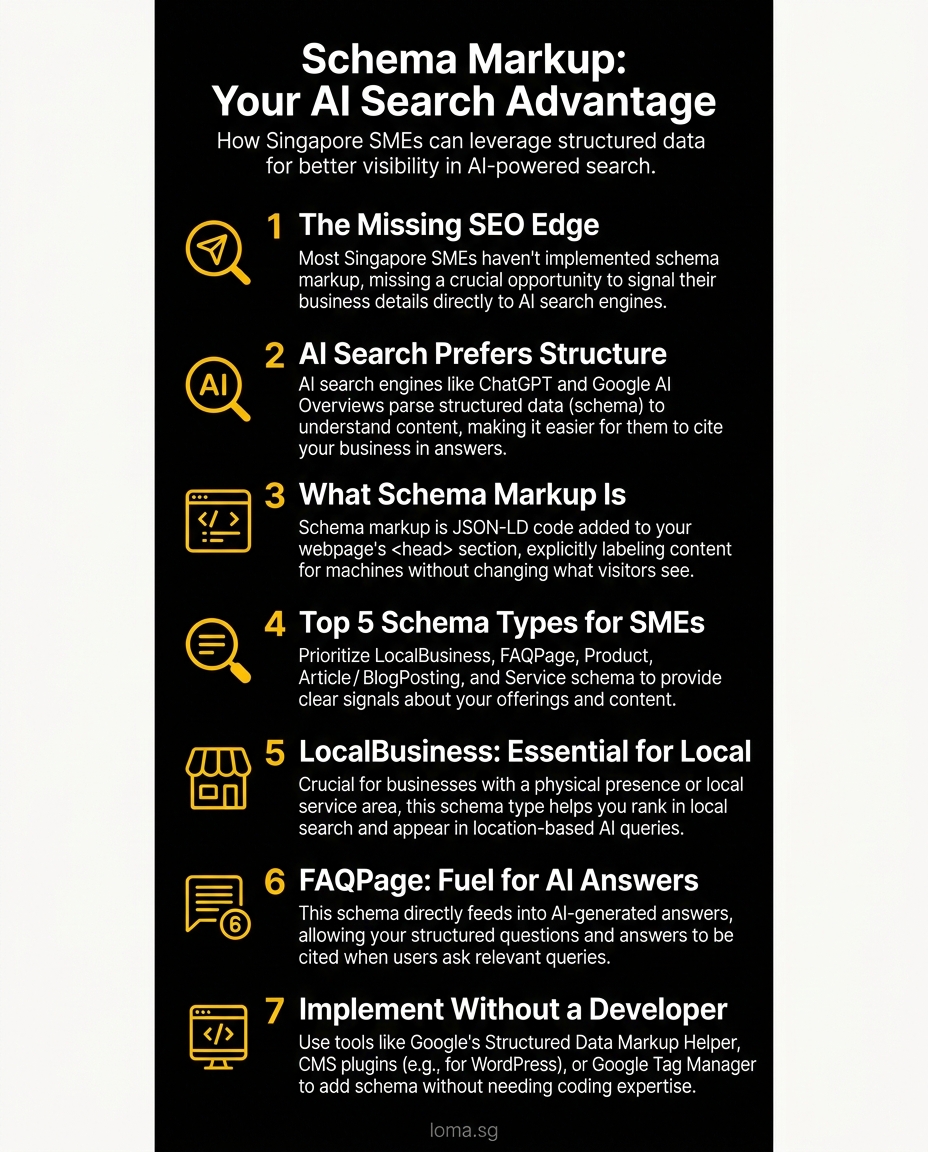
1. LocalBusiness
What it signals: Your name, address, phone number, opening hours, geographic coordinates, and business category.
Who needs it: Every business with a physical location or local service area. Non-negotiable if you want to rank in local search or appear when AI answers location-based queries.
Implementation note: Use the most specific subtype available. A dental clinic should use Dentist, not MedicalBusiness. A restaurant should use Restaurant, not FoodEstablishment. The more specific, the clearer the signal. Include geo coordinates (latitude/longitude) alongside your address for better local search precision.
2. FAQPage
What it signals: A set of questions and answers about your business, product, or topic.
Who needs it: Any page that answers common customer questions. This includes service pages, product pages, and blog posts structured around a key question.
Implementation note: FAQPage schema is one of the most direct feeds into AI-generated answers. When Perplexity or Google AI Overviews present a bulleted answer to a question, they often pull from structured FAQ content. If your questions closely match what users are actually searching, your content has a strong chance of being cited. Each Question entity requires a name (the question) and an acceptedAnswer with a text field. Keep answers concise but complete.
3. Product
What it signals: Name, price, availability, SKU, brand, and review ratings for a specific product.
Who needs it: Any eCommerce business. This is critical if you want your products to appear in Google Shopping or in AI answers when someone asks "where can I buy X in Singapore?".
Implementation note: The offers field (price, availability, currency) is required for Google to show price-enhanced snippets. AggregateRating pulls in your review score. If your product availability changes frequently, make sure the schema is dynamic — static schema showing "InStock" for a sold-out product will get flagged.
4. Article / BlogPosting
What it signals: That a piece of content is a published article, who wrote it, when it was published, and when it was last updated.
Who needs it: Any business publishing blog content, guides, or news. Particularly useful for agencies, service businesses, and B2B companies investing in content marketing.
Implementation note: datePublished and dateModified are both important. Updated content with a recent dateModified gets treated as fresher and more authoritative by AI systems. Include author with an author page URL if possible — this contributes to Google's E-E-A-T (Experience, Expertise, Authoritativeness, Trustworthiness) signals.
5. Service
What it signals: The specific services your business offers, including description, area served, and pricing (if applicable).
Who needs it: Agencies, consultants, clinics, law firms — any service business. Underused by most SMEs, but one of the highest-value schema types for appearing in AI answers to "what service does X offer?" or "who provides Y in Singapore?".
Implementation note: Each distinct service should have its own Service entity. Link it back to the parent LocalBusiness using provider. Include areaServed with specific geographic coverage (city, region, or country). If you have different service tiers or packages, you can nest Offer entities with price ranges.
How to Add Schema Without a Developer
Three practical methods, depending on your setup:
Method 1: Google's Structured Data Markup Helper
Free, no code required. Go to https://www.google.com/webmasters/markup-helper/, paste in your page URL, and tag the elements on your page visually. The tool generates the JSON-LD. Copy it, paste it into your page's <head>. Done.
Best for: Business owners who want to add LocalBusiness or Article schema without touching code.
Method 2: Your CMS WordPress with Yoast SEO or RankMath auto-generates basic schema (Article, Organisation, BreadcrumbList) on all pages. Configure your business details in the plugin settings and the core schema gets added automatically. For more advanced types (FAQPage, Service), both plugins let you add them page-by-page via their block editors.
On Webflow or Framer, you'll need to add JSON-LD manually in the page's <head> section via the custom code settings. These platforms don't auto-generate schema, but the insertion process is straightforward if you're comfortable with the CMS interface.
Method 3: Google Tag Manager For teams managing multiple pages or dynamic content, GTM lets you deploy schema at scale without modifying the codebase. You can write schema templates with dynamic variables (pulling product names, prices, or availability from the data layer) and push them across your site via a custom HTML tag. More setup upfront, but far more maintainable at scale.
Always test before publishing: Google's Rich Results Test (https://search.google.com/test/rich-results) shows whether your schema is valid and which rich result types it qualifies for. Run every page through this after adding or updating schema. It catches syntax errors and missing required fields before they cause issues.
Mistakes That Kill Your Schema
Marking up content that isn't on the page. Schema is supposed to describe visible page content. Adding FAQPage schema with questions and answers that don't appear on the page is a violation of Google's guidelines. They've started issuing manual penalties for this. If the schema says your business is open until 9pm and your page says 6pm, that's also a problem.
Leaving required fields empty. Every schema type has required fields. LocalBusiness needs name, address, and telephone. Product needs name, image, description, and offers. Missing required fields means the schema won't qualify for rich results, even if it's syntactically valid.
Using Microdata instead of JSON-LD. Microdata is the older format, where schema attributes are embedded directly in your HTML tags. Google still supports it, but JSON-LD is the recommended format and far easier to maintain. If your developer set up schema five years ago, check which format they used.
Never testing after changes. Adding new pages, updating product information, or changing your CMS plugin can break existing schema without any obvious error on the front end. Build a habit of running Rich Results Test checks when you push significant site updates.
Schema and GEO: The Compounding Effect
Schema markup makes your content machine-readable. GEO implementation makes your content worth citing. Together, they create multiple entry points for AI systems to reference your business.
Think of it this way: GEO-optimised content gives AI engines something worth quoting. Schema markup tells them exactly who's being quoted and what context to attach to that citation. Your business name, your service area, your specialisation, your customer questions you've answered — all of it is explicitly labelled.
Without schema, your GEO content might still get cited, but the citation is less precise, less attributable, and less likely to include your specific business details (address, contact, niche) rather than just your ideas.
A GEO SEO strategy that includes technical foundations like structured data consistently outperforms one that treats them as separate workstreams. That's not an accident. It reflects how AI search actually works: the clearer your signals, the more confidently an AI can cite you, and the more specifically it can describe what you offer.
Most agencies running "SEO" in 2026 still treat schema as optional. It's not. It's table stakes for any business that wants to appear in AI-generated search results, not just traditional blue links.
Start With LocalBusiness and FAQ
If you've never added schema and don't know where to start: LocalBusiness first, then FAQPage.
LocalBusiness gets your foundational information into the record — who you are, where you are, what hours you keep. Every other schema type builds on top of this base. FAQPage gets you directly into the format AI search engines most commonly use when generating answers.
Both can be set up in under an hour without a developer. The Google Structured Data Markup Helper handles LocalBusiness in minutes. FAQPage just requires writing your actual customer questions and answers into a JSON-LD block.
If you want your business to appear in AI-generated answers, not just traditional search results, LOMA builds GEO strategies that include technical foundations like schema markup. Talk to our team.