
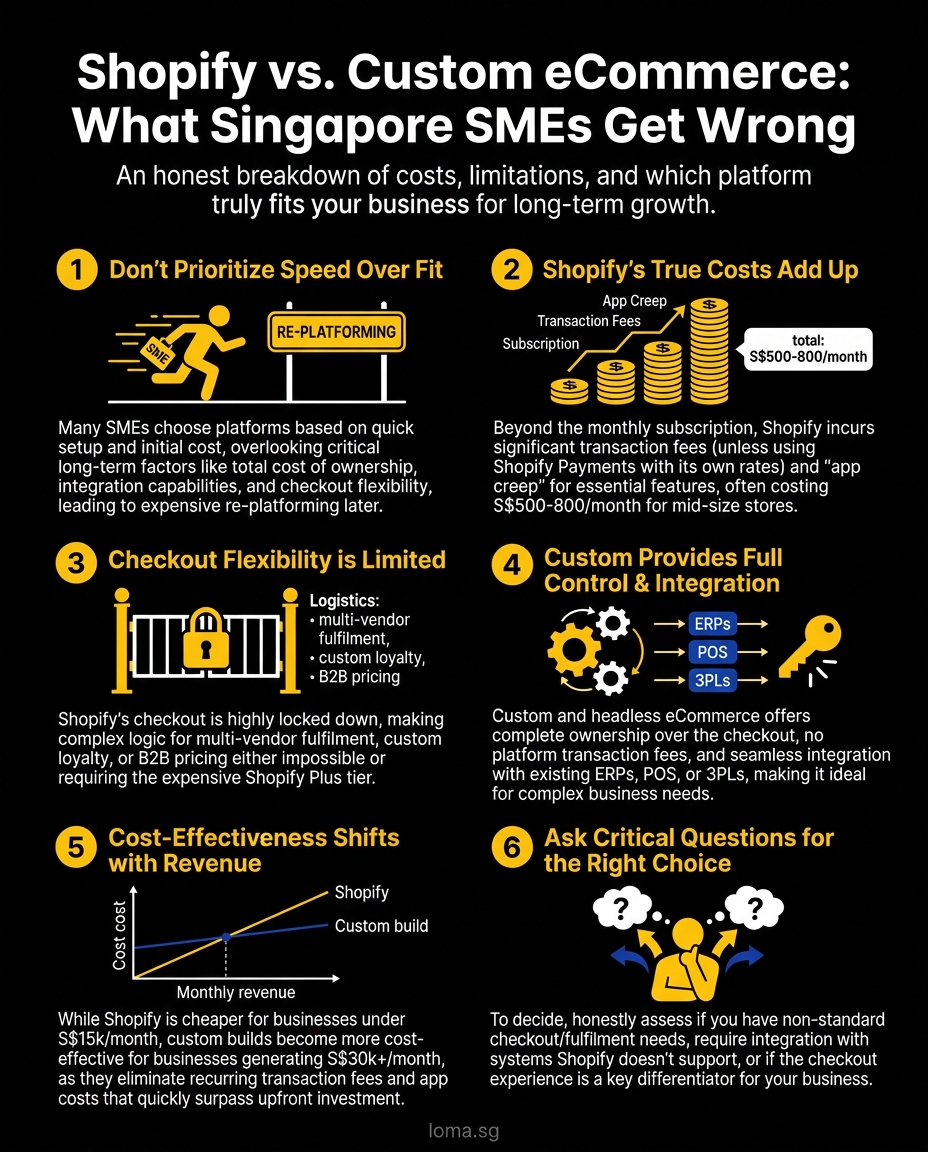
Most Singapore businesses pick an eCommerce platform after a 30-minute demo and a glance at the pricing page. Six months later, they're writing support tickets about checkout limitations, staring at a bill they didn't plan for, or realising their platform simply cannot connect to their warehouse system.
The platform decision is not glamorous. Nobody blogs about it excitedly. But it is one of the most consequential decisions in any ecommerce website design project — because switching later is expensive, disruptive, and entirely avoidable.
This is an honest breakdown of Shopify versus custom eCommerce. Not a vendor pitch. Not a "10 reasons Shopify sucks" takedown. Just the factors that actually matter, laid out so you can make the right call for your business.
Why This Decision Gets Made Badly
Ease of setup is not the same as fit for growth.
Shopify wins the initial pitch almost every time. It has beautiful templates, a smooth onboarding flow, and the ability to go live in days. That speed is real and valuable. But speed to launch and speed to your first major operational constraint are often the same thing.
The factors that determine whether a platform will still work for you in 18 months rarely come up in the initial comparison:
- Total cost of ownership, not just monthly subscription
- Integration capability with your existing or planned business systems
- Checkout flexibility when you have non-standard fulfilment or discount logic
- What platform lock-in costs you if you need to migrate later
Nobody gets excited evaluating these on day one. But they're exactly what separates the right platform decision from an expensive do-over.
What Shopify Actually Gives You (Honestly)
Shopify is a good product. It earned its market position.
What you actually get: a fast path to a working online store, a mature ecosystem of apps and integrations, solid out-of-the-box SEO, and a hosting infrastructure you never have to think about. For most small businesses, these things genuinely matter. You want to sell, not manage servers.
Here's what Shopify doesn't advertise as loudly:
Transaction fees. On the Basic plan (~S$40/month), Shopify charges 2% on every transaction unless you use Shopify Payments. Shopify Payments is available in Singapore, but it comes with its own processing rates (roughly 2–3.5% depending on volume and plan tier). For a business doing S$30,000/month in revenue, that 2% adds up to S$600/month before you count anything else.
App creep. Shopify's core product is deliberately lean. Reviews, loyalty programs, upsell flows, subscription billing, advanced email segmentation, B2B pricing: all of these require third-party apps. Budget S$50–300/month per serious app. It's not unusual for a mid-size Shopify store to spend S$500–800/month on apps alone, on top of the platform subscription.
Checkout limitations. Shopify's checkout is notoriously locked down. You can customise the look and some fields, but complex checkout logic (multi-vendor fulfilment, custom loyalty redemption, B2B-specific pricing by customer group) either requires Shopify Plus (~US$2,000/month) or simply isn't possible.
Plan tiers. Shopify Basic is S$40/month, Shopify is S$105/month, Advanced is S$400/month. Each tier unlocks better reporting and lower transaction fees. But if you need real checkout flexibility, you're looking at Shopify Plus pricing, which is a completely different category of expense.
Who Shopify is right for: Small catalogues, early-stage D2C brands, founders who need to launch fast and validate product-market fit, businesses that don't anticipate complex integrations or checkout requirements.
What Custom and Headless eCommerce Actually Gives You (Honestly)
Custom eCommerce is often described as "flexibility" — which is vague. Here's what that means in practice.
You own the checkout entirely. Every field, every flow, every integration point is under your control. No transaction fees beyond your payment gateway's standard rate. No app subscriptions for features that should be core to the platform. No vendor telling you a feature you need is only available on a plan that costs 20x more.
Headless commerce specifically separates your storefront (the customer-facing frontend) from the commerce engine underneath. This means you can build any front-end experience you want — in any framework — and connect it to the commerce backend. It also means you can swap out components over time rather than being tied to a monolithic system.
The integration story is the biggest difference. A custom build connects to whatever you need: existing ERP systems, POS hardware, custom loyalty programs, 3PL providers, B2B pricing engines. There's no "does Shopify have an app for this?" moment.
What custom eCommerce does not give you: fast initial launch, zero maintenance responsibility, or a low upfront price. A well-built custom ecommerce website requires a developer or agency to build it, hosting costs you need to manage, and ongoing maintenance you need to budget for.
Who custom eCommerce is right for: Businesses with non-standard checkout or fulfilment requirements. Brands growing past S$30–50k/month in revenue where transaction fees and app costs start to bite. Businesses that need serious backend integration. Anyone where the checkout experience is a genuine differentiator.
The Real Cost Comparison
This is where most comparisons get dishonest by being incomplete.
| Cost Line | Shopify (Growth Stage) | Custom / Headless |
|---|---|---|
| Platform subscription | S$105–400/month | S$0 |
| Transaction fees (2% on S$30k rev) | S$600/month | S$0 |
| Core app stack (reviews, loyalty, email, upsell) | S$400–800/month | Varies (often built-in) |
| Shopify Plus (if needed) | ~S$2,800+/month | Not applicable |
| Initial build / setup | Low (DIY or agency) | S$8,000–30,000+ |
| Hosting | Included | S$50–200/month |
| Ongoing maintenance | Low (Shopify handles it) | Agency retainer or in-house |
The honest conclusion: for a business doing S$5,000–15,000/month in revenue, Shopify wins on cost at the start. The all-in monthly cost is predictable and relatively low, and you're not spending five figures upfront on a build.
For a business doing S$30,000/month or planning to get there within 12–18 months, the maths shifts. The transaction fees and app stack alone can easily exceed S$1,000–1,500/month. A custom build that eliminates those costs over 24 months often pays for itself.
This is not a reason to over-engineer your stack early. It's a reason to be honest about where you expect to be in 18 months before you commit to a platform.
Three Questions That Tell You Which to Choose
If you're still unsure, answer these honestly:
1. Do you have non-standard checkout or fulfilment requirements? Not "we'd like nice-to-have features." Real constraints: B2B pricing tiers, multi-location fulfilment with different lead times, custom discount logic, subscription products with complex rules. If yes, custom deserves serious consideration. Shopify will fight you on these.
2. Do you need to integrate with systems Shopify doesn't natively support? If your business runs on a custom ERP, a legacy POS, a specific 3PL that doesn't have a Shopify app, or a loyalty program built in-house, the Shopify app ecosystem may not help you. A custom build connects to anything with an API.
3. Are you planning for significant volume within 12–18 months? If you're projecting meaningful growth, model out the all-in Shopify cost at that volume now. Transaction fees and app subscriptions scale with your revenue and complexity. A custom build costs more upfront but the marginal cost of growth is much lower.
If the answer to all three is no, start on Shopify. Go live, learn, and revisit when you hit friction. That's not a bad strategy.
If the answer to any of them is yes, the custom path deserves a proper evaluation before you commit.
Where LOMA Comes In
For businesses whose requirements point toward custom or headless eCommerce, LOMA builds on Medusa: an open-source composable commerce platform. No ongoing platform fees, full ownership of your codebase, and clean integration with any backend system.
We build custom ecommerce websites designed to handle what growing businesses actually need — not just a storefront that looks good, but one that connects to your operations and scales without forcing you into a more expensive plan.
Every custom build we do starts with the same conversation: what does your business actually need to do, and what happens if you outgrow it?
That's also true of the AI assistant capabilities we layer into eCommerce projects — AI that connects to your actual product and inventory data, not a generic chatbot bolted on after the fact.
Whether you're evaluating platforms for the first time or re-evaluating because you've hit friction on your current one, checkout optimisation starts well before you pick a theme — it starts with the platform decision itself.
A solid ecommerce website design is not just about how your store looks. It's about whether the platform underneath can do what your business needs it to do.
Make the Right Call Before You Build
The worst outcome in eCommerce platform selection is not picking Shopify when you should have gone custom, or vice versa. It's committing to a platform, building your business on top of it, and realising 18 months later that the switching cost is more painful than the friction you're in.
Neither platform is universally right. The right answer depends on where your business is, where it's going, and what it actually needs to do.
If you're planning an eCommerce build and want to make sure the platform fits your business, not just your budget, LOMA builds custom Medusa storefronts for Singapore brands. Talk to us before you commit to a platform.