
Every marketing software vendor has rebranded itself as "AI-powered" in the past two years. Which makes the question "should I use AI marketing automation?" almost impossible to answer — because the term now covers everything from a grammar checker to a fully autonomous campaign system.
For Singapore SMEs running lean marketing teams (or no dedicated team at all), cutting through this noise matters. The leverage from automating even two or three workflows is disproportionately high when you're a two-person operation doing everything manually. But the wrong automation creates new overhead, produces generic output, and makes your marketing worse.
So the more useful question is this: which tasks in your marketing workflow are repeatable enough that AI handles them well, and which ones require judgment that AI consistently gets wrong? Get that distinction right first, and the tool choices follow naturally.
The Problem With How AI Marketing Automation Is Sold
Most AI marketing tools are sold on a single promise: time savings. "Save 10 hours per week." "Automate your entire email workflow." "Publish 30 days of social content in 60 minutes."
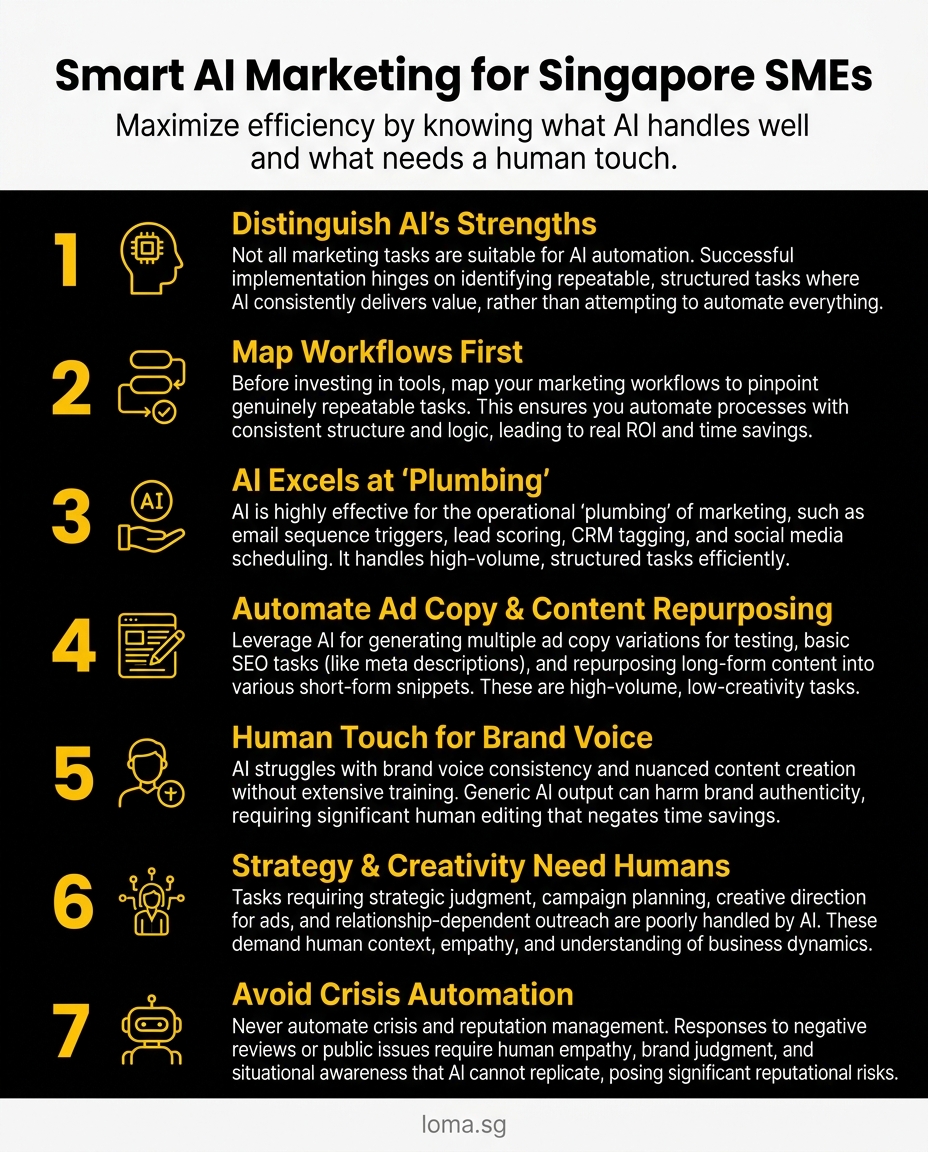
The pitch isn't wrong, exactly — it's just incomplete. AI automation genuinely excels at high-volume, structured, repeatable tasks. It falls apart on anything requiring brand voice consistency, strategic judgment, or nuanced human context. When you buy a tool based on the time-savings pitch without understanding where its limits are, you end up spending time correcting AI output instead of producing it yourself. Net result: zero time saved, and sometimes a worse outcome.
The businesses that get real ROI from AI marketing automation are the ones who mapped their workflows before they bought anything. They identified the tasks that are genuinely repeatable — same structure, same logic, same type of output every time — and automated those. Everything else stayed human.
What AI Automation Actually Handles Well
These are the marketing tasks where AI delivers consistently and the effort-to-output ratio genuinely shifts in your favour.
Email Sequence Triggers and Delivery Logic
AI doesn't write better email than a skilled copywriter. What it does well is the plumbing: segmenting your list based on behaviour, triggering the right sequence at the right time, and personalising at a scale you can't do manually. A new lead downloads your guide, gets tagged as "high intent", receives a 5-email nurture sequence timed to their activity, and lands with your sales team pre-qualified.
The human still writes the emails (or should). The AI manages the orchestration. That division works.
Social Media Scheduling and Performance Reporting
Scheduling tools have been around for a decade. The AI layer now adds automated performance summarising (which posts drove the most traffic, what engagement patterns look like by day and content type) and can surface insights without you digging through dashboards. Not transformative — but genuinely useful background work that saves an hour every week.
Ad Copy Variation Testing
Generating 10 headline variants for a Google ad, then testing which one performs best, is exactly the kind of structured, high-volume task AI handles efficiently. You still need to define the brief: what the ad is for, who the audience is, what the CTA is. But instead of writing 10 variants yourself, you generate them in minutes and spend your time selecting and refining. That trade-off makes sense.
Lead Scoring and CRM Tagging
If your CRM has enough data — website visits, email opens, content downloads, form fills — AI can score and tag leads without manual review. For most SMEs, this replaces a messy manual process (or no process at all) with something consistent and automatic. The output isn't perfect, but it's better than eyeballing a list and guessing.
Content Repurposing
Turning a 1,500-word blog post into five LinkedIn snippets, three email subject line options, and a summary for your newsletter — this is structured enough that AI handles it reliably. You still edit the output. But the first draft is done in minutes, not an hour.
Basic SEO Tasks
Meta description drafts, schema markup generation, internal linking suggestions based on existing content — these are high-volume, low-creativity tasks where AI delivers consistent output at a fraction of the time. For an SME managing 50+ blog posts without a dedicated SEO team, this kind of support compounds over time. (For a deeper look at how AI is reshaping AI SEO specifically, that's worth a separate read.)
What It Handles Poorly — and Where SMEs Waste Money
This section is where AI marketing automation tools earn less than they promise, and where the hype-versus-reality gap is sharpest.
Brand Voice Generation Without Tight Training
Generic AI content is instantly recognisable. It uses the same sentence structures, the same qualifiers ("it's worth noting that"), and the same filler phrases regardless of your brand. Unless you've invested significant time training your AI tools on your specific voice, examples, and constraints, the output sounds like every other AI-generated post online. The problem isn't that AI can't write — it's that writing a blog post is not a structured, repeatable task. The quality of the output depends on judgment calls that vary every time.
Strategy and Campaign Planning
AI can summarise market trends. It cannot tell you whether to run a brand awareness campaign or a performance campaign given your current stage, budget, and competitive position. That decision requires context — about your business, your sales cycle, your margins, your competitive dynamics — that AI does not have. Giving this to an AI and acting on the output is genuinely risky.
Relationship-Dependent Outreach
Personalised cold email and LinkedIn outreach that sounds personalised and isn't — people can tell. The "I noticed you recently posted about X and thought you'd be interested in Y" format has been so widely automated and misused that it now signals inauthenticity. Automating outreach at the expense of genuine personalisation costs more in credibility than it gains in reach. The LinkedIn marketing context matters here: relationship-building requires human judgment.
Creative Direction for Ads
AI can generate ad copy variations. It cannot decide which creative direction will resonate with your audience based on the cultural and situational context you understand as a business owner. Creative strategy is a judgment call dressed up as an art form. It should stay human.
Crisis and Reputation Management
If a negative review goes viral or a product issue surfaces publicly, the response requires human empathy, brand judgment, and situational awareness. Any business that automates this is taking a reputational risk that no time saving justifies.
A Practical Automation Stack for a Small Professional Services Firm
Here is what a concrete implementation looks like for a three-person professional services firm — not a hypothetical, but a pattern we see repeatedly.
What they automated:
- Email nurture sequences for new leads (5-email sequence, triggered by contact form submission, timed to website activity)
- Monthly social scheduling across LinkedIn and Instagram (content approved manually, scheduling automated)
- Weekly GA4 reporting summary (automated via Google Looker Studio dashboard connected to GA4, removes the need to manually pull data)
- Blog post meta description drafts (AI generates first draft, editor reviews and publishes)
Tools used: ActiveCampaign for email automation, Buffer for social scheduling, Looker Studio for reporting, ChatGPT or Claude for meta description drafts. Total tool cost: roughly S$150–200/month.
Setup time: About 12 hours across two weeks, mostly configuring the email sequences and reporting dashboard.
Actual time saving: Approximately 6–8 hours per month on recurring tasks. That is not a huge number in isolation, but for a founder or small team where those hours were previously spent on manual admin, the value is real.
The key: they did not try to automate content creation or campaign strategy. Those stayed human. The content marketing workflow driving their blog is still a person writing and editing, with AI helping with formatting and repurposing — not generating the ideas or drafts.
How to Audit Your Current Marketing for Automation Opportunities
This takes about 30 minutes and gives you a prioritised list of what to automate first.
Step 1: List every recurring marketing task. Write down everything your team does on a weekly or monthly basis. Publishing social posts, sending newsletters, updating reports, responding to leads, running ad checks, uploading content. Be specific.
Step 2: Categorise each task. Label each task as either "repeatable/structured" (same steps, same type of output every time, low judgment required) or "judgment-heavy" (requires context, creative thinking, or situational awareness). Most tasks will fall clearly into one category or the other.
Step 3: Map the repeatable ones to available tools. For each "repeatable/structured" task, identify whether a tool already exists that handles it reliably. Focus on tools with proven track records in that specific function — scheduling tools for scheduling, CRM automation for lead flows, reporting tools for data aggregation.
Then start with one. Not five. Implement it properly, measure the actual time saving, and let that inform whether to expand. Most automation failures happen because businesses try to automate everything at once and end up managing broken workflows instead of reducing them.
The email marketing automation workflow is usually the right place to start — high value, well-understood tools, and measurable results within weeks.
Where LOMA Fits
AI marketing automation is not a product — it is a system. The tools are only as good as the workflow they sit inside, and the workflow only works if someone designed it properly.
LOMA builds AI-assisted marketing systems for SMEs: diagnosing which tasks are actually worth automating, setting up the right tool stack, and integrating it into how your team already works. Not a subscription you figure out yourself — a system built for your specific context.
If you want AI-assisted marketing built into your workflow — not a tool subscription you never fully use — LOMA designs and implements AI marketing systems for Singapore businesses. If you're looking for ongoing execution rather than system design, that's what our digital marketing service is built for.