
The output is only as good as the brief. Here's how to write one your AI can actually work with.
Most marketers have tried ChatGPT or Claude at least once. Many have gotten something usable on the first attempt, felt good about it, and then spent the next ten sessions getting mediocre copy that required more editing than if they'd written it themselves.
The problem is almost never the AI tool. The problem is the prompt. Getting your AI prompts for marketing right matters more than which tool you choose.
Generic input produces generic output. That's not a flaw. It's a feature working as designed. AI tools generate text based on what you give them. If your brief is vague, the output will be vague. If your brief is specific, detailed, and structured, the output will be specific, detailed, and structured.
This guide is for marketing leads and business owners at Singapore SMEs who've moved past the beginner stage but haven't made AI-assisted content systematic. By the end, you'll have a clear framework for writing prompts, ready-to-use templates for the most common marketing tasks, and an honest answer to where AI still falls short.
Why Most AI Prompts Fail
The most common marketing prompt looks like this:
"Write a LinkedIn post about our new service."
This is the blank brief. You'd never brief a copywriter this way. You wouldn't walk up to a designer and say "make something nice." But with AI tools, people expect a single sentence to produce publish-ready content, then blame the tool when it doesn't.
The underlying issue is that AI has no context unless you give it context. It doesn't know your brand, your audience, your competitors, your tone, or what "good" looks like for your business. Without those inputs, it fills the gaps with averages: the average LinkedIn post, the average tone, the average structure. Average is rarely what you need.
The second failure mode is treating AI like a search engine. "What's a good headline for a landing page?" is a search query. What you want is output, so give the AI the raw materials it needs to produce that output. Role, audience, format, tone, constraints. Every one of these narrows the space of possible responses and moves you closer to something usable.
The Anatomy of a Good Marketing Prompt
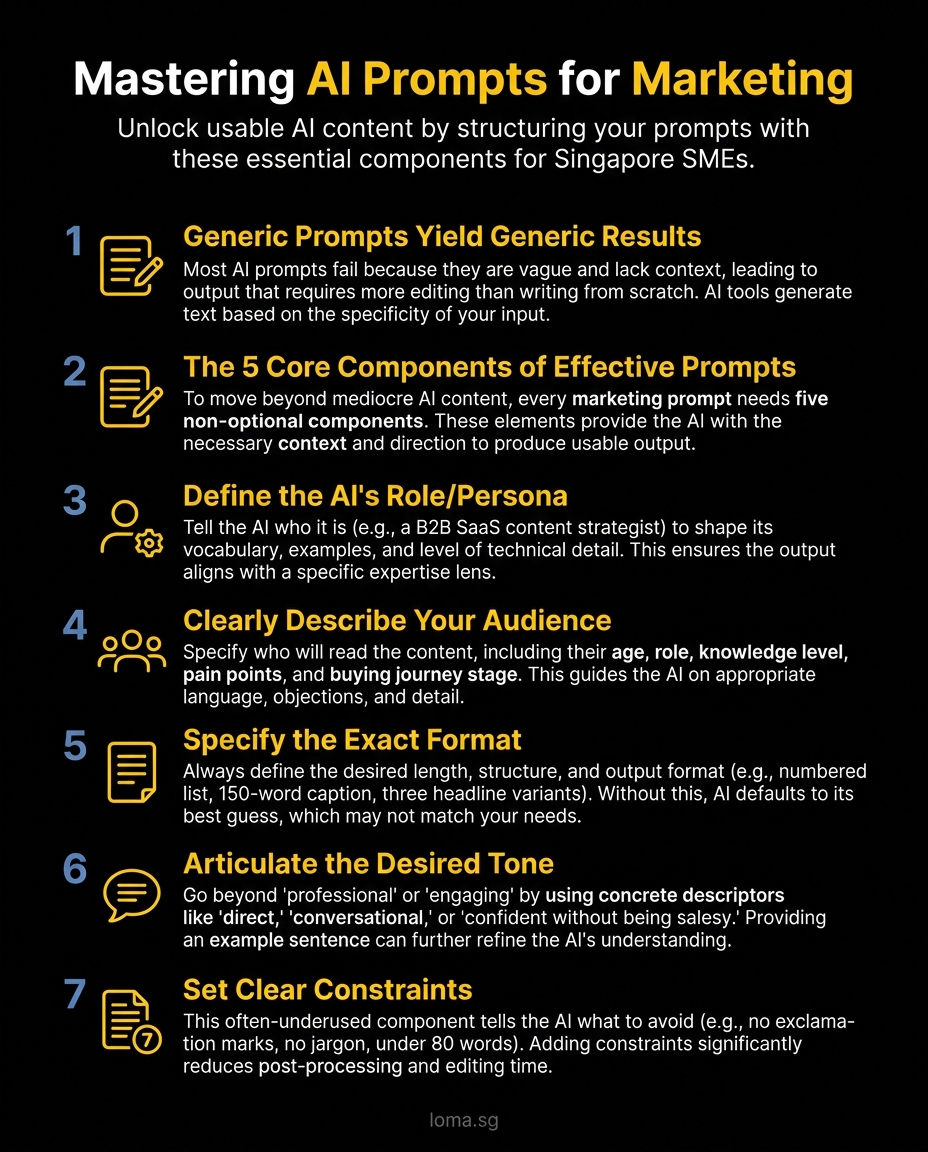
A prompt that produces usable marketing copy has five components. None of them are optional.
1. Role / Persona
Tell the AI who it is.
Not "you are a helpful assistant" (that's the default). Tell it the specific expertise lens you want it to write from.
Generic: "Write a blog post about content marketing."
With role: "You are a content strategist at a B2B SaaS company. Write a blog post about content marketing for companies that sell to operations managers."
The role shapes vocabulary, examples, level of technical detail, and what the AI treats as common knowledge.
2. Audience
Describe who will read or see this content. Age, role, knowledge level, pain point, and where they are in the buying journey all matter.
Generic: "Write ad copy for our software."
With audience: "Write Google ad copy for a project management tool. The audience is operations managers at manufacturing companies in Singapore, 35-55 years old, frustrated with spreadsheets but skeptical of complex software. They're in the awareness stage: they haven't started evaluating tools yet."
The second prompt tells the AI what language to use, what objections to anticipate, and what level of technical detail is appropriate.
3. Format
Specify exactly what you want: length, structure, output format. If you want a numbered list with a summary, say that. If you want three headline variants with a rationale for each, say that. If you want 150-word copy with no subheadings, say that.
Without format, AI defaults to its best guess, which may be three paragraphs when you wanted bullet points, or a 500-word article when you needed 100 words for a social caption.
4. Tone
"Professional" is not a tone. Neither is "engaging."
Describe tone with specifics: direct, conversational, dry wit, no jargon, confident without being salesy, warm but not fluffy. The more concrete your description, the closer the output will be to your actual brand voice.
Better still: give an example sentence that captures the tone you want, and tell the AI to match it.
5. Constraints
What should the output avoid? This is the most underused component.
Constraints might include: no exclamation marks, no made-up statistics, no superlatives ("the best", "world-class"), no mention of competitors, no em dashes, keep it under 80 words.
Every constraint removes a class of outputs that would require editing. The more constraints you add, the less post-processing you need.
Prompt Templates for Common Marketing Tasks
Each template below has two versions: a filled example so you can see what good looks like, and a blank version you can copy and adapt.
Blog Post First Draft
Filled:
You are a content strategist writing for a digital marketing agency blog in Singapore. Write a 1,200-word article for marketing managers at SMEs (20-100 employees) who are frustrated with inconsistent content output. The article should explain how to build a simple content production system using AI tools. Tone: direct, practical, no fluff. Structure: H2 subheadings, short paragraphs, numbered lists where appropriate. Avoid jargon, no exclamation marks, no AI hype.
Blank:
You are [role] writing for [publication/audience]. Write a [length] article for [audience description] who [pain point or situation]. The article should [main takeaway or objective]. Tone: [tone description]. Structure: [format details]. Avoid: [specific restrictions].
Social Media Caption Set
Filled:
Write five LinkedIn captions for a digital marketing agency promoting a free AI marketing audit. Audience: founders and marketing leads at B2B companies in Singapore, 10-50 employees. Each caption should be under 150 words, start with a different opening hook, and end with a soft CTA (not "click here", not "sign up today", something conversational). Tone: confident, plain English, no marketing buzzwords.
Blank:
Write [number] [platform] captions for [company type] promoting [offer]. Audience: [audience description]. Each caption should be [length], start with [hook type], and end with [CTA style]. Tone: [tone description].
Email Subject Line Variants
Filled:
Write ten email subject line variants for a re-engagement email to SME business owners who downloaded a free guide three months ago but haven't engaged since. Each subject line should be under 50 characters, imply value without being clickbait, and avoid spam trigger words. Include one version that uses a question, one that uses urgency, and one that uses curiosity. No emojis.
Blank:
Write [number] email subject line variants for [campaign type] to [audience segment]. Each should be under [character count], [tone or style criteria]. Include one version that [variant A], one that [variant B], and one that [variant C]. Avoid: [restrictions].
Ad Headline and Body Copy
Filled:
Write three Google ad headline sets for a web development agency in Singapore. Each set should have three headlines (max 30 characters each) and two descriptions (max 90 characters each). Target audience: SME founders searching for "website redesign Singapore". Highlight: fast turnaround, AI-assisted builds, local agency. Avoid: generic phrases like "best in class", "one-stop-shop", or "comprehensive solutions".
Blank:
Write [number] Google ad [headline/description] sets for [business type] in [location]. Each set should have [format specs]. Target audience: [audience description]. Highlight: [USPs]. Avoid: [specific phrases or patterns].
SEO Meta Description
Filled:
Write three meta description variants for a page about AI-assisted SEO services in Singapore. Each should be 150-160 characters, include the keyword "AI SEO Singapore", and end with a soft CTA. The page targets marketing managers at growth-stage companies. Tone: direct and confident, not salesy. No exclamation marks.
Blank:
Write [number] meta description variants for a page about [topic]. Each should be 150-160 characters, include the keyword "[target keyword]", and end with [CTA type]. Target audience: [audience]. Tone: [tone]. Avoid: [restrictions].
The One Edit That Changes Everything
Most marketers use AI tools as standalone sessions. Each prompt starts from scratch, with no carry-over context. That's fine for one-off tasks, but it's the reason your AI-generated content sounds inconsistent: different vocabulary, different sentence length, different personality across pieces.
The fix is a voice block: a short paragraph that captures your brand voice, which you paste into every marketing prompt.
Here's an example:
"Write in a direct, confident tone. Short sentences. No hedging. No exclamation marks. No marketing clichés like 'game-changer' or 'leverage'. The brand sounds like a senior consultant who has seen it all and isn't trying to impress anyone. Blunt, honest, occasionally dry. Not rude, but not soft either."
That's 52 words. Added to any prompt, it shifts the output significantly.
Write your own version once. Paste it in. Update it when your voice evolves. It takes ten minutes and it's probably the highest-leverage thing you can do to improve AI output consistency.
What AI Still Won't Do Well
Better prompts produce better output. But there are things that better prompts can't fix.
Original insight. AI can synthesise what exists. It can't tell you something nobody has written before: a surprising finding from your own client data, a counterintuitive take based on something you saw in the market this week. Original insight requires someone who knows something. AI borrows it.
Specific data. If you want to cite a stat, use a real one. AI tools can and do generate plausible-sounding statistics that don't exist. Any number in AI-generated content should be verified before publishing.
Relationship-building content. The kind of content that builds real trust tends to be personal: a story about a mistake, a behind-the-scenes account of how something worked, a genuine opinion that could get pushback. AI can imitate that style, but it can't supply the experience. You supply the story. The AI helps you write it.
Anything that requires knowing something the AI doesn't know. Current events, your specific client situation, internal context, recent industry shifts that happened after the model's training cutoff. These gaps don't disappear with better prompting. They require a human in the loop.
The practical rule: use AI to reduce the time spent on first drafts, reformatting, and variations. Keep a human in the loop for anything that requires real judgment, original data, or relationship context.
Building AI Into Your Marketing System
Prompting AI one request at a time is a significant improvement over writing everything from scratch. But it's still a manual process.
The next step is making AI a built-in part of your content operations: systematic brief creation, consistent voice application, structured review, and publishing workflows that don't depend on someone remembering to prompt the right thing at the right time.
That's what LOMA builds for SMEs: AI-assisted marketing operations that combine the consistency of a system with the flexibility to adapt as your business evolves. Not a chatbot on your website, but a full production layer.
If you're still spending hours every week on first drafts, caption variants, and copy revisions, it's worth a conversation. The workflow exists. The prompts are solved. What's missing is the system that runs it.
Talk to LOMA about AI marketing operations
Related reading: What Is Generative Engine Optimization (GEO)? | AI SEO Agency Singapore: What to Look For