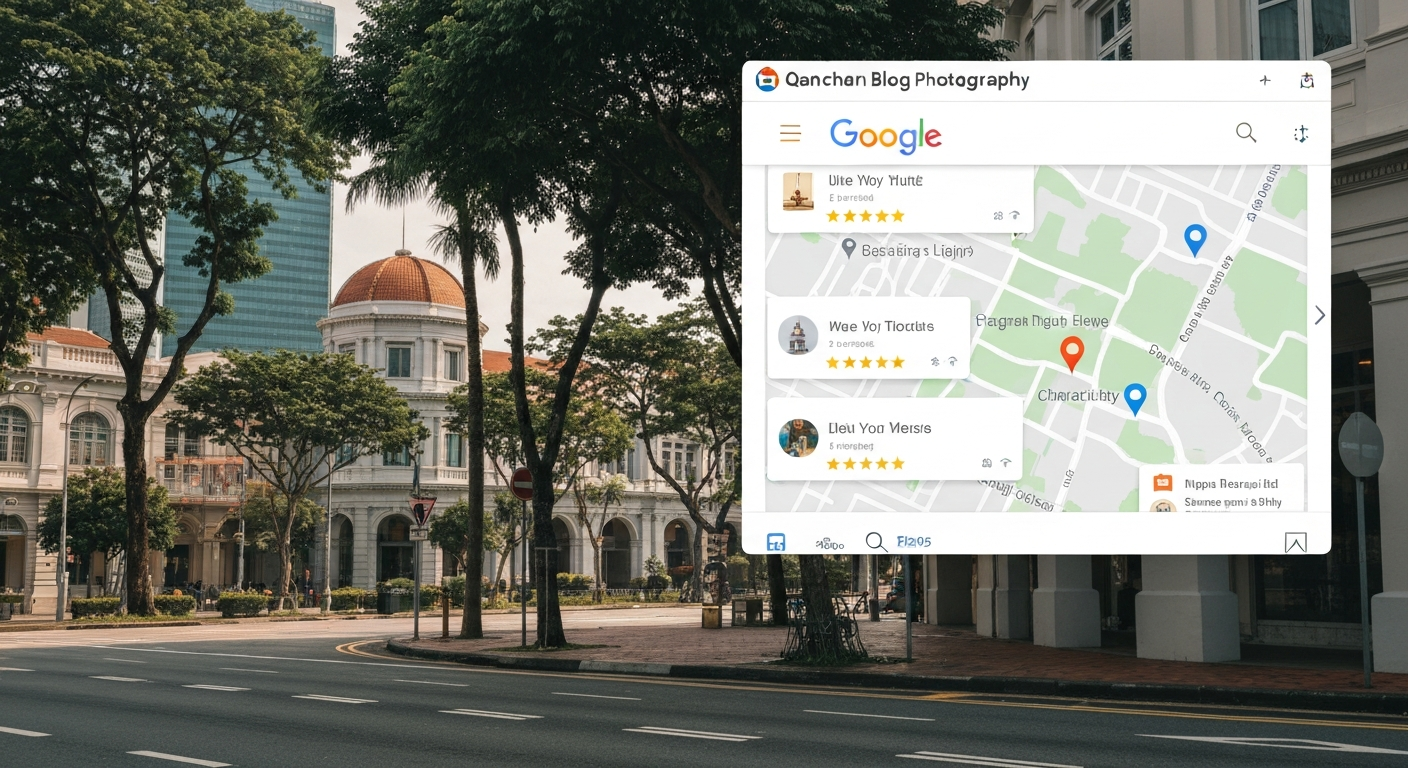
When someone in Tanjong Pagar searches "dentist near me" or "best char kway teow Bukit Timah", Google doesn't return a list of ten blue links. It shows a map with three pinned results: ratings, opening hours, a call button, and a directions link. That's the Map Pack. The businesses in it win the click before any website enters the picture.
Local SEO is the practice of getting your business into that Map Pack for the searches your customers are already making. If your business has a physical location, serves a specific area, or depends on foot traffic, local SEO for Singapore SMEs isn't a nice-to-have: it's the most direct line between a search query and a paying customer standing at your door.
Most SMEs assume that having a website covers them on Google. It doesn't. Local search is a separate game with its own rules, its own ranking signals, and a specific set of actions that move the needle. Here's what they are.
Why Local SEO Is Not the Same as Regular SEO
Standard SEO is about ranking in the organic results: the ten blue links below the ads. Local SEO is about ranking in the Map Pack: the three pinned listings that appear above those organic results for location-based queries.
The Map Pack gets the majority of clicks for searches like "accountant in Jurong" or "aircon servicing Ang Mo Kio." If you're not in it, you're not really visible for those searches, regardless of where you rank organically.
The ranking factors are different too. For standard SEO, domain authority, content quality, and backlinks dominate. For local SEO, Google cares most about: your Google Business Profile, NAP (Name, Address, Phone number) consistency across the web, and review signals. These are things your website alone cannot fix.

Google Business Profile: The Foundation of Local Search
Your Google Business Profile (GBP) is the single most important asset in local SEO. Everything else builds on top of it.
What a Complete Profile Looks Like
A complete, optimised GBP isn't just filled out. It's actively maintained. Start with the basics:
- Business name: Exactly as it appears in the real world. No keyword stuffing (e.g., "Bright Dental Clinic Singapore Teeth Whitening" is a policy violation and a red flag to Google).
- Category: Choose the most specific primary category available. Add secondary categories for ancillary services. A GP clinic that also offers health screening should have "General Practitioner" as primary and "Medical Laboratory" or "Health Consultant" as secondary.
- Address and phone number: Must be consistent with what appears on your website and everywhere else online. More on this below.
- Opening hours: Updated and accurate, including public holidays. Customers who find you closed when you said you'd be open leave negative reviews.
- Website and appointment link: Both fields should be filled where relevant.
- Business description: Write naturally, include your target keyword once. Three to four sentences max.
- Photos: Upload at least 10 photos: exterior (so customers can find you), interior, team, products or services. Profiles with photos receive significantly more direction requests than those without.
What Most Businesses Miss: Ongoing Activity
Filling out the basics gets you to baseline. Active maintenance is what separates ranked profiles from invisible ones.
Respond to every review. Every single one. Thank happy customers specifically (not with copy-paste responses), and address negative reviews calmly and constructively. Google treats response rate as a quality signal. Customers read it as a proxy for how you run your business.
Post regular updates. GBP has a Posts feature that most SMEs never touch. Use it for: new products or menu items, seasonal offers, upcoming events, or useful content for your customers. Posts signal an active, legitimate business.
Answer Q&A proactively. Anyone can ask questions on your profile, and anyone can answer them. Pre-populate the Q&A section with the questions customers actually ask you. This fills a gap before a stranger fills it incorrectly.
NAP Consistency: The Detail That Quietly Kills Rankings
Google's local algorithm cross-references your business information across dozens of sources to verify you are who you say you are. If your name, address, or phone number appear differently across directories, even small discrepancies like "Pte Ltd" vs "Pte. Ltd." or "+65 9XXX XXXX" vs "9XXX XXXX", Google's confidence in your business decreases.
Run a NAP audit across: your website footer, Google Business Profile, Facebook page, Yelp Singapore, Yellow Pages Singapore, BusinessList.sg, and any industry-specific directories you appear in (e.g., Healthhub for medical businesses, HDB commercial directories for hawker centres). Old addresses after a move are the most common source of inconsistency.
This isn't glamorous work. But fixing NAP inconsistencies on a 5-year-old business often produces visible ranking improvements within 4–8 weeks.
Reviews: The Most Underestimated Ranking Signal
Google treats review volume, recency, and sentiment as direct local ranking signals. More importantly: potential customers read them before deciding.
A clinic with 85 reviews and a 4.7-star average will typically outrank a clinic with 12 reviews and a 4.9 average, all else being equal. Volume matters.
Building a Review System That Works
The highest-converting review request is a direct WhatsApp message with a one-click link. Here's how: open your Google Business Profile dashboard, click "Get more reviews", copy the short review link. Save it as a template in WhatsApp Web. Send it to satisfied customers immediately after their visit or transaction.
Timing is everything. A request sent within an hour of a positive experience converts far higher than a request sent three days later. Most SMEs never ask at all, which is why their review count stays flat while competitors who do ask compound their ratings month over month.
One rule: ask for honest feedback from satisfied customers. Do not ask for "5-star reviews." That violates Google's policy, sounds fake, and erodes trust if customers notice the phrasing.
Local Keyword Targeting on Your Website
Your GBP alone won't carry full local SEO. Your website needs to send matching signals.
Page titles and H1s: Include your location naturally where it makes sense: "Dental Clinic in Bishan" not "Best Top Dental Clinic Bishan Singapore Affordable." One location per page. Don't force it.
Contact page: Should include your full address, an embedded Google Map, and your phone number in text (not just an image). This is a basic trust and local relevance signal that many websites skip.
Service area pages: If your business serves multiple neighbourhoods or towns, create a dedicated page for each major one. A cleaning company serving Tampines, Bedok, and Pasir Ris should have individual pages targeting each area, not one page that mentions all three in a list.
Locally-relevant FAQ: Write answers to the questions customers actually type into Google. "How much does aircon servicing cost in [area]?" "Is there parking at [your address]?" These capture long-tail local searches and improve your relevance signals.
Local Link Building: The Overlooked Signal
Links from other businesses and publications in your area tell Google you're geographically embedded in your market. This doesn't require an elaborate outreach campaign.
Practical starting points:
- Local business directories: Get listed in BusinessList.sg, Yellow Pages Singapore, and your industry association's member directory (e.g., Singapore Dental Association, CASE-approved retailers).
- Local media mentions: A mention in a neighbourhood blog, a food review on HungryGoWhere, or a feature in a local lifestyle publication carries genuine local authority signals.
- Community partnerships: Sponsor a grassroots club, partner with a complementary business (a gym recommending your physio, a café recommending your bakery), or participate in a local event. Most of these produce a natural link from their website to yours.
- Supplier and partner pages: If you stock specific brands or work with well-known partners, ask if they'll list you as an authorised dealer or preferred partner on their Singapore pages.
Quality over quantity. Five links from genuine Singapore sources carry more local signal than fifty from generic global directories.
Tracking: How to Know If It's Working
Local SEO compounds over three to six months. Set a baseline early and track the right metrics.
Google Business Profile Insights shows: search queries people used to find your profile, profile views, website clicks, direction requests, and call button clicks. Direction requests and call clicks are the most direct indicators of local search driving physical customers.
Google Search Console shows impression and click data for your website from local searches. Filter by queries containing your location or "near me" to isolate local performance.
Check both monthly. Look for trajectory, not just snapshot numbers. A business that grows direction requests from 40 to 65 month-over-month is building momentum even if they're not yet in the top three.
For a deeper understanding of how local SEO fits into a broader search strategy, read our SEO fundamentals guide for Singapore businesses and our overview of AI-powered SEO approaches.
If you're running both local SEO and paid campaigns, our guide on common Google Ads mistakes will help you avoid wasting budget while your organic presence builds. And once local SEO starts driving traffic, make sure your site is ready to convert it with our guide on website conversion rate optimisation.
For SMEs managing multiple marketing channels at once, our overview of full-stack digital marketing explains how these pieces fit together.
Ready to Get Your Business Ranking Locally?
Most SMEs spend months wondering why competitors keep showing up on Google Maps while they don't. The answer is almost always: their competitors optimised for local search and yours haven't yet.
LOMA builds local SEO programmes for SMEs from the ground up: Google Business Profile setup and optimisation, NAP audits, review systems, local content, and link building. Not just rankings. Qualified local traffic from customers who are already looking for what you do.