
TikTok marketing in Singapore is having a moment, and every agency post about it says the same thing. The algorithm is powerful. Organic reach is massive. You need to be there yesterday.
None of them tell you honestly whether it's worth your time. Or for which types of businesses it actually converts versus burns budget and attention. This post does.
If you're a Singapore SME founder or marketing lead wondering whether TikTok deserves a place in your channel mix, here's the framework you actually need.
Why TikTok in Singapore Is Different From the Global Story
The global narrative around TikTok is mostly built on the US experience. Viral moments, massive organic reach, creator economy, brand awareness at scale. That's real, but it's not the whole picture for businesses operating here.
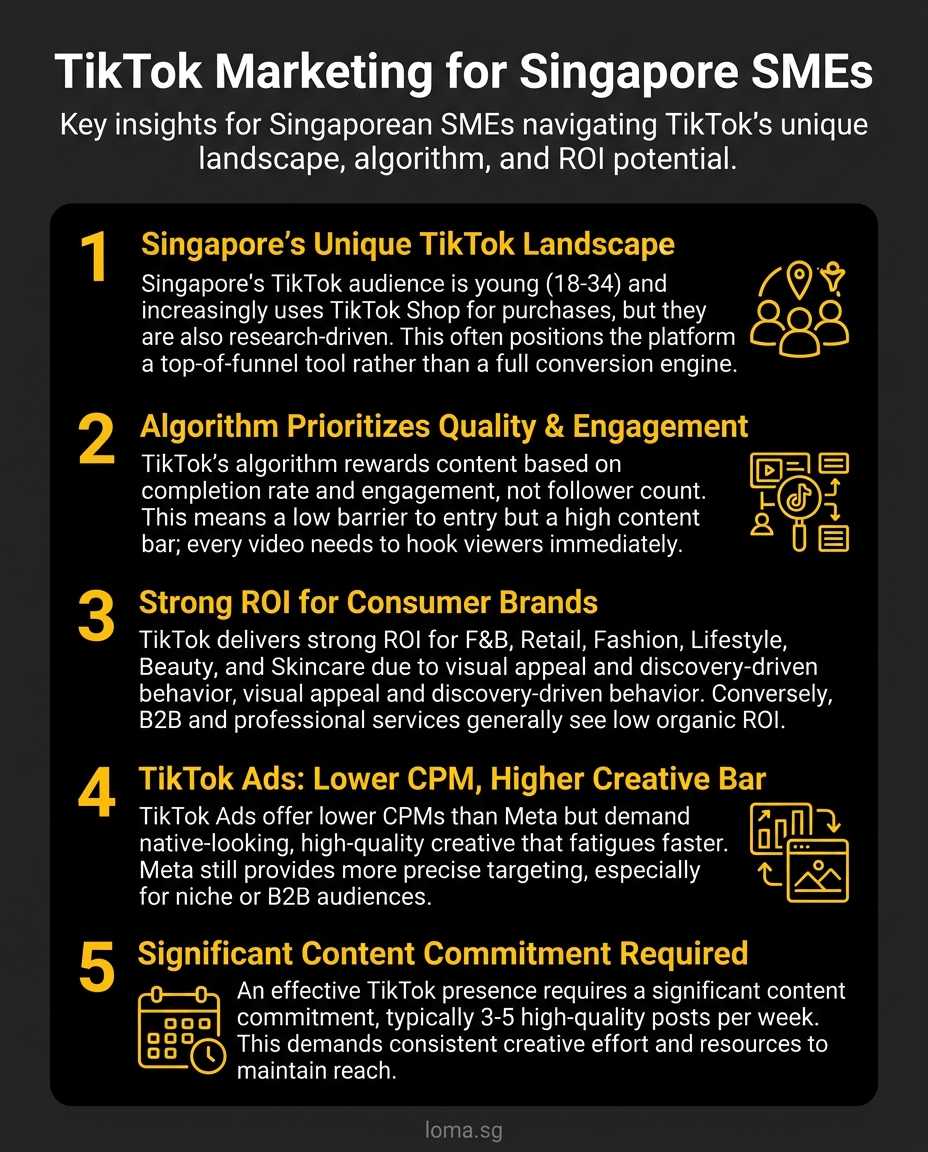
Singapore's TikTok user base skews young: 18–34 is the dominant demographic. That's not a surprise. But what does matter for SMEs is that Southeast Asia, including Singapore, has seen stronger purchase behaviour on TikTok than Western markets. TikTok Shop has genuine traction in the region. Consumers here are increasingly buying, not just watching.
That said, Singapore's market has a nuance the hype often glosses over. Singaporean consumers tend to research before purchasing, even for relatively low-ticket items. You're not typically reaching impulse buyers. You're reaching people who will discover your product on TikTok, go look at your website, check Google reviews, then decide. The platform is often the top of the funnel, not the full funnel.
Set expectations accordingly. TikTok can be powerful. It won't replace your website or your conversion engine.
What TikTok Actually Rewards
Before you post a single video, understand how the algorithm distributes content. It's different from Meta and Instagram in a way that matters.
TikTok distributes content based primarily on completion rate and engagement signals, not follower count. A brand new account with zero followers can reach thousands with one strong video. A 50,000-follower account gets suppressed if its content is routinely skipped.
What this means: the barrier to entry is low. You don't need an existing audience to get reach. But the content quality bar is real and immediate. If your first video doesn't hook people in the first two seconds, it dies in the algorithm. Nobody sees it.
This is fundamentally different from building a Facebook page where you accumulate an audience over time and then reach them. On TikTok, every video is a fresh audition. You earn reach video by video.
The implication: consistency plus quality matters more than frequency alone. Posting five mediocre videos a week will get you less reach than posting two that actually land.
Which Business Categories See Real ROI
This is the section most agency posts skip. Not every business benefits equally from TikTok. Here's an honest breakdown:
F&B: Strong Food content is native to TikTok. Discovery-driven behaviour, "where to eat in Singapore," "hidden gem cafes," "try this before it's gone", is well-established on the platform and maps directly to foot traffic. If you run a cafe, restaurant, or food brand, TikTok is one of the highest-ROI channels for visibility. You don't even need a large budget. A well-shot 30-second video of your signature dish hitting a table can reach tens of thousands of people in Singapore organically.
Retail, Fashion, Lifestyle: Strong, especially with TikTok Shop Product demos, unboxing, styling videos, these convert directly. TikTok Shop integration means a viewer can buy without leaving the app. If you're selling physical products with visual appeal, this is a channel worth taking seriously. The creative format (authentic, short, product-forward) suits these categories well.
Beauty and Skincare: High-performing Tutorial content, honest reviews, before-and-after transformations, this is some of TikTok's best-performing content globally, and Singapore is no exception. Beauty brands, both large and indie, see strong returns here. The key is authenticity: polished corporate-style beauty ads do not perform as well as real people showing real results.
Education and Courses: Growing, but format-dependent Quick insight clips that build credibility can work well. The "you didn't know this" format does generate views and follows. However, converting that attention into course enrolments is harder than it looks. If you're an educator or training provider, TikTok works for awareness and authority, not as a direct response channel. Treat it as a long-game credibility play.
B2B and Professional Services: Low organic ROI This is the honest answer most agencies won't give you. If you're a B2B company, a professional services firm, or a business selling to other businesses, TikTok organic content rarely drives qualified leads. You might get views. You probably won't get deals. The platform's demographic and intent don't match B2B purchase journeys. TikTok Ads can work for some B2B categories (particularly when targeting by interest and behaviour rather than business role), but organic content as a lead gen channel for B2B is a poor use of time.
TikTok Ads vs Meta Ads for Singapore SMEs
If you're considering paid, here's a direct comparison.
Cost: TikTok Ads CPMs (cost per thousand impressions) are currently lower than Meta in Singapore. You can reach more people per dollar on TikTok, which sounds great until you factor in the creative requirement.
Creative bar: TikTok Ads must look native. Content that looks like a traditional ad, polished, scripted, produced, gets skipped and performs poorly. You need to produce content that feels like organic TikTok. That means a higher creative investment per ad, and faster creative fatigue. Where a Meta ad might run for three to four weeks before performance drops, TikTok creatives often need refreshing within two to three weeks.
Targeting precision: Meta's targeting is more precise for niche and high-intent audiences. If you're trying to reach Singapore homeowners aged 40–55 interested in home renovation, Meta gives you more control. TikTok's targeting is improving but still lags Meta for granular audience definition, especially for B2B and professional demographics.
TikTok Shop Ads: For product-based businesses already on TikTok Shop, in-feed ads tied to product listings can close the loop between discovery and purchase in one step. This is a genuine advantage for consumer product brands.
Summary: For consumer product businesses, F&B, retail, beauty, lifestyle, TikTok Ads are worth testing alongside Meta. For service businesses with defined target audiences, Meta still has the edge. Don't abandon Meta for TikTok; test them in parallel and let the data guide allocation.
The Content Commitment: What It Actually Takes
Here's the hidden cost nobody talks about enough.
Minimum effective TikTok presence: three to five posts per week. Not one, not two. Three to five, and they need to feel native, not produced. The platform rewards consistency and punishes irregular posting with reduced distribution.
This means one of two things. Either a founder or team member who is willing to be on camera and genuinely engaging (not scripted, not corporate, real), or investment in a social content creator who can produce native-feel content consistently. Many SMEs underestimate what this looks like until they're three weeks in and have already run out of ideas.
The time cost is real. Between ideation, filming, editing, captions, and posting, a serious TikTok presence takes 8–12 hours a week minimum, for a small team. That's attention pulled from sales, operations, or other marketing channels.
This is not an argument against TikTok. It's an argument for being clear-eyed before committing.
How to Decide: Two Questions
Before you launch a TikTok presence or shift budget to TikTok Ads, answer these two questions honestly.
1. Is your target customer actively on TikTok?
Consumer under 40 in Singapore: almost certainly yes. B2B decision-maker or a customer demographic that skews 45 and above: less certain. Check your Google Analytics and your existing customer data. If your current buyers don't match the TikTok demographic, you'd be creating content for an audience that isn't buying from you.
2. Do you have the content production capacity or budget to sustain it?
Not the budget for one campaign. The sustained capacity for three to five videos a week, every week, for at least three months. That's the test period to see real results. If you don't have that capacity in-house and don't have budget to build it, TikTok will waste your time.
If yes to both: run a proper 60–90 day test. Define success metrics upfront (reach, traffic, leads, conversions, depending on your business type). Review at the end and make a data-driven call.
If no to either: double down on the channels you're already running. TikTok will still be there when your capacity is ready.
The Bottom Line
TikTok is not right for every Singapore SME. For F&B, retail, beauty, and lifestyle businesses with a consumer audience, it's one of the most powerful channels available right now, with a lower paid media CPM than Meta and genuine organic reach for strong content. For B2B businesses and professional services, the ROI case is weak.
The businesses that win on TikTok are the ones who commit fully, consistent posting, native content, and patience for the first 30–60 days while the algorithm learns your account. The ones who lose are the ones who post sporadically, treat it like a polished ad channel, and expect results after five videos.
Know which category you're in before you start.
If you're evaluating your social media and digital marketing mix and want a clear picture of where to focus, LOMA's digital marketing services are built for exactly that, honest channel strategy, not hype. We also work with SMEs on social media marketing and can help you understand how TikTok fits alongside Meta Ads and content marketing as a long game.